









Copyright © 2026 Fluent Conveyors, LLC. All rights reserved.
The Fluent Conveyors logo is a registered trademark of Fluent Conveyors, LLC. Serial Number 97664258 Registered on Dec. 12, 2023


Copyright © 2026 Fluent Conveyors, LLC. All rights reserved.
The Fluent Conveyors logo is a registered trademark of Fluent Conveyors, LLC. Serial Number 97664258 Registered on Dec. 12, 2023

In 2022, U.S. asphalt mix producers turned out 441.9 million tons of asphalt mixture. Nearly every ton of pavement removed before repaving moves across a conveyor belt on the back of a cold planer. Integrally molded belts are the single-piece, cleated discharge belts that carry hot, abrasive millings from the cutting drum to the haul truck. This page covers how they're built, how they fail, and what drives service life.

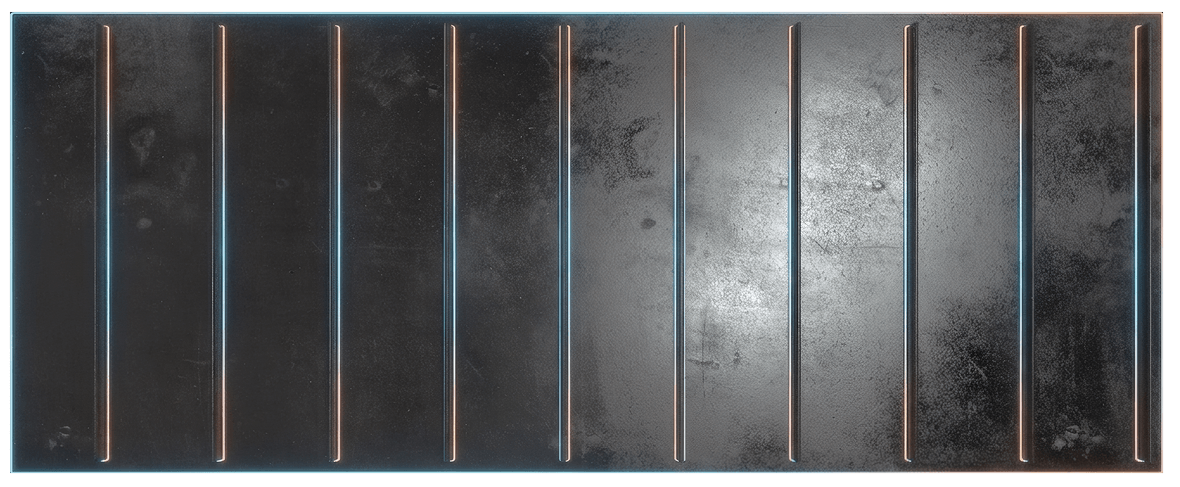
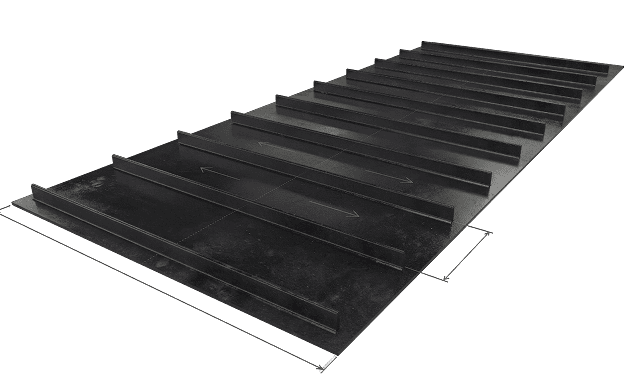
An integrally molded belt is a single cured unit. The carcass, the top and bottom covers, and the cleats are bonded into one continuous piece of material rather than assembled from a flat belt with cleats mechanically fastened or hot-vulcanized on top. Heavy-duty integrally molded belts handle applications that would rapidly degrade belts composed of assembled pieces.
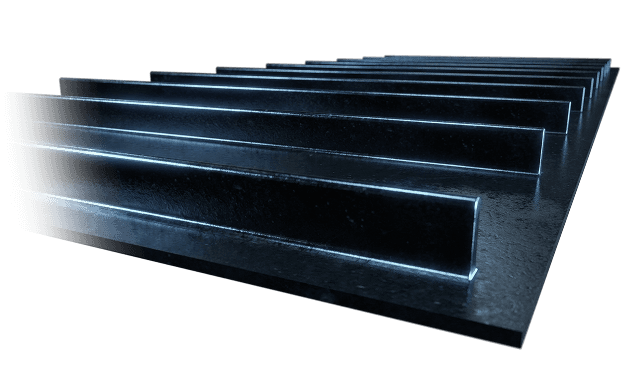
Reclaimed asphalt pavement (RAP) involves conditions that degrade general-purpose belts.
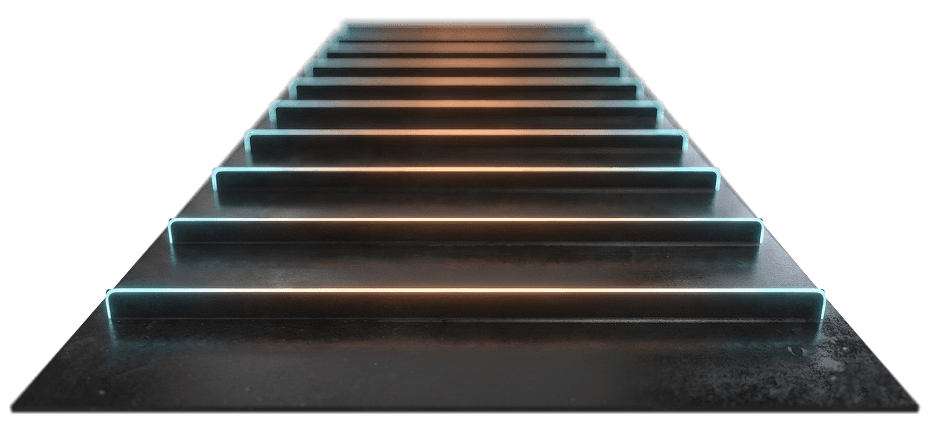
Any cleat bond, splice joint, or layer interface on an assembled conveyor belt becomes a potential failure point within the first few hundred operating hours. Integrally molded construction removes failure points for better service in extreme conditions.
Milling belts have the compound chemistry and the construction to survive the impact, heat, and chemical wear.

Service life on an integrally molded milling belt comes from four design variables.

The carcass is the load-bearing structure. It’s made of multiple plies of polyester or nylon fabric that carry tensile force down the belt and resist longitudinal stretch. Ply count and fabric weight are sized to the pulling force the belt sees at working tension (with headroom for impact spikes at loading). An undersized carcass stretches and mistracks; an oversized one adds stiffness that works against the small pulley diameters cold planers use.
The covers are the wear surfaces. The top handles impact and abrasion from the material, and the bottom handles friction against the pulleys and slider surface. Milling belts typically use a moderately oil-resistant (MOR) rubber compound that balances cut-and-gouge resistance against asphalt binder exposure.
Top cover thickness directly increases service life. Thicker top covers can take more abrasion damage, but they add weight and stiffness. Field practice on cold planers is to match top cover thickness to expected run hours between belt changes, not to specify the thickest available option.
Cleat height determines how much material the belt can carry up a given incline before the material slips back. Cleat spacing determines how fluid the discharge is. Too close, and material packs between cleats, too far, and retention drops off at the top of the run. Profile (chevron, bullhorn, plain, or proprietary shapes) determines how material flows off the belt at the discharge end. The right configuration is machine-specific and incline-specific.
An endless vulcanized splice approaches the mechanical properties of the surrounding belt material; a mechanical splice trades some service life for field-replaceability. The choice depends on how the operator wants to handle belt replacement.
Milling planers share the same basic discharge architecture across platforms. A primary belt pulls material off the cutter drum; a secondary belt transfers it from the primary to the haul truck. Both positions see the same RAP, but the primary runs short and steep inside the machine enclosure, while the secondary runs longer and slews to the side.
Integrally molded belts are standard on both positions across major OEM platforms. What changes between machines is geometry. Belt width, length, cleat profile, spacing, and pulley diameter all vary by model.
For related context, see our asphalt conveyors and best conveyor for aggregates pages.
Belt selection for a milling application comes down to five variables:
Once the belt is on the machine, service life is driven more by mechanical care than compound choice. Proper belt tensioning prevents the carcass from cycling outside its design range, correct tracking keeps the belt off the frame, and clean scrapers keep carryback from abrading the cover surface from underneath. Small, disciplined maintenance practices extend life more than any compound upgrade.
For more selection guidance, see how to choose the correct conveyor belt and how to make a conveyor belt last longer.

Fluent Conveyors is a U.S. manufacturer that builds replacement integrally molded belts to OEM fitment for any major cold planer platform. Send us the machine model and the position you're replacing, and we'll work through the cleat profile, compound, and splice method to match the duty cycle.
