





Copyright © 2026 Fluent Conveyors, LLC. All rights reserved.

The Fluent Conveyors logo is a registered trademark of Fluent Conveyors, LLC. Serial Number 97664258 Registered on Dec. 12, 2023


Copyright © 2026 Fluent Conveyors, LLC. All rights reserved.
The Fluent Conveyors logo is a registered trademark of Fluent Conveyors, LLC. Serial Number 97664258 Registered on Dec. 12, 2023

To replace a flat idler, shut down the conveyor, apply lockout/tagout, support the belt, pull the worn idler, measure before you order, drop in the replacement square to the frame, and verify tracking on an empty run before returning to service.
Continue reading for detailed steps, troubleshooting, and replacement idler ordering guidance.

Gather these before you start:
Wrench or socket set for mounting hardware
Tape measure or calipers for recording dimensions
Straightedge for checking perpendicularity
Boards or blocking for belt support
Wire brush or rag for cleaning bracket seats
Camera or phone for documenting the existing setup
Replacement retainer clips and hardware, if required
PPE per your facility policy
Before you begin, isolate all energy sources and apply lockout/tagout per your facility's LOTO program. OSHA 29 CFR 1910.147 requires written procedures, energy isolation, and verification before servicing work begins. For conveyor-specific requirements, see OSHA 29 CFR 1926.555.
Only authorized employees should perform this work. Consult your equipment manual for the lockout procedure specific to your conveyor. See our OSHA compliance page for more information.
Once the system is de-energised, secure the belt to avoid these hazards:
Stored belt tension
A loaded belt holds significant tension. When you remove an idler from underneath it, the belt can drop or spring if it isn't supported. Isolating electrical power does not release belt tension.
Gravity on inclines
On inclined conveyors, de-energizing the drive doesn't arrest belt movement. Confirm the belt is blocked or restrained before you reach into the frame.

Before you start, gather your replacement part, hardware, belt support material, measuring tools, and PPE.

Confirm the failure mode before disassembly. You might only need to replace a roller. Or you might need to replace the assembly and inspect the system for upstream issues that caused the idler to fail. Photograph the idler, shaft end orientation, and mounting hardware before anything comes apart.
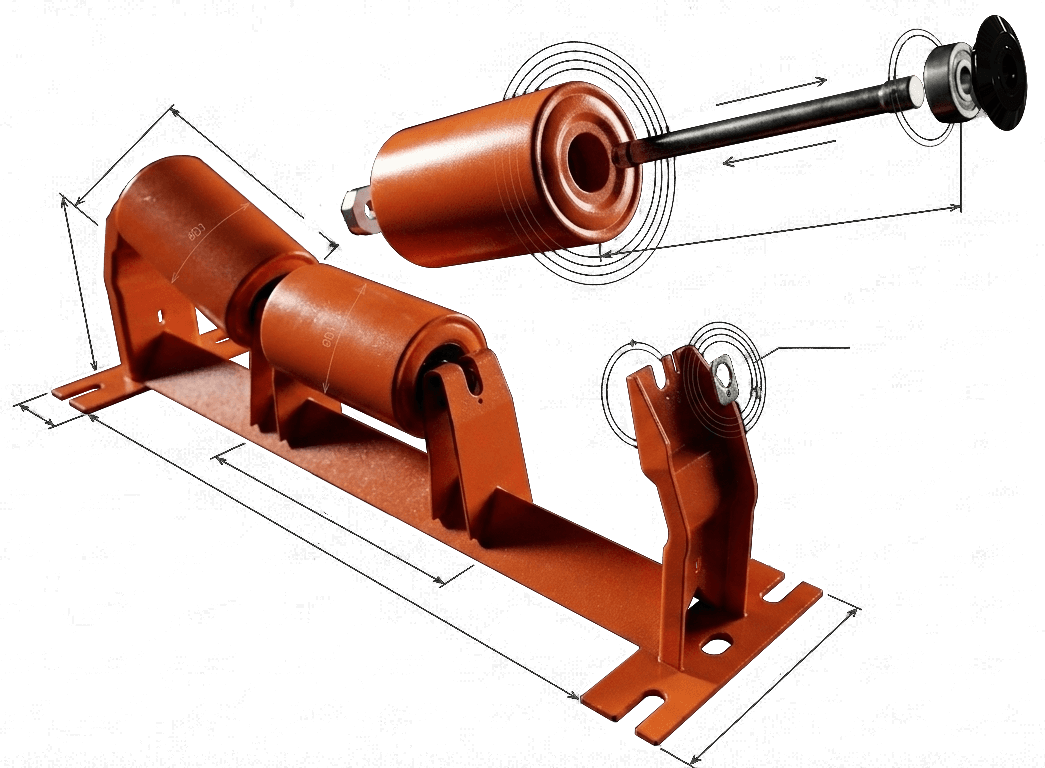
Measure the existing idler while it's still in the frame. Capture face width, shaft diameter, shaft end style, and bracket hole spacing. See the Dimensions and part identification section for the full checklist.
Place boards or blocking under the belt on both sides of the work area. This prevents belt drop during the swap and keeps the belt position controlled while the idler seat is empty.
Authorized personnel only. Document guard removal so everything goes back in the right sequence.
Loosen fasteners with the conveyor belt supported and the area clear. Remove retainer clips if present; note their orientation for reinstallation.
Slide or lift the old idler out. Note the shaft end orientation if the design is directional.
Clean debris from bracket seats and mounting holes. Check for bent brackets, elongated holes, corrosion, and weld integrity. Don't install a new idler into a damaged frame; it will fail early and may cause immediate belt mistracking.
Seat shaft ends fully in the hanger brackets. Align mounting holes before inserting fasteners. Install retainer clips.
The roller must sit perpendicular to the conveyor frame before you apply the final torque. Check perpendicularity before tightening. Uneven torque or a cocked idler causes immediate mistracking regardless of whether the dimensions are correct.
Confirm all guards and access panels are back in place and secured.
Release lockout/tagout only after guards are reinstalled. Run the conveyor empty and confirm the belt tracks centered before returning to loaded operation. See Alignment and restart checks below for acceptance criteria.
Most flat idlers allow drop-in roller replacement when the assembly is otherwise sound. Before you order, determine which scope applies.
Swap the roller only when:
The shell is worn, flat-spotted, or the bearing has failed
The hanger brackets are undamaged and shaft seats are intact
Mounting holes are round (not elongated or corroded)
The assembly is a standard bracketed design with accessible shaft ends
Replace the full assembly when:
Brackets are bent, cracked, or show elongated mounting holes
Shaft seats are corroded, deformed, or no longer hold the shaft square
Frame welds at the bracket attachment points are compromised
The idler is a non-serviceable sealed unit where the roller isn't field-replaceable
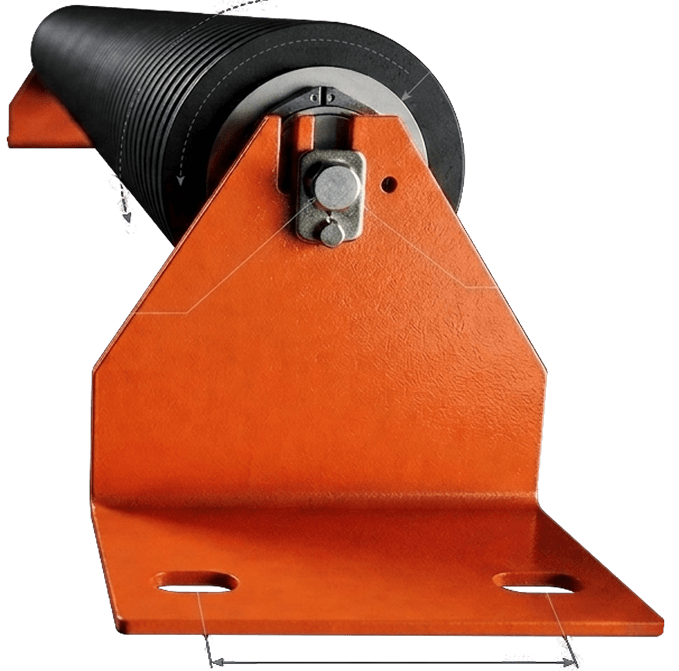
Before you schedule the downtime, confirm you have the right part.
Confirm that the CEMA class matches or exceeds the original. Dropping to a lower class reduces load capacity below the design spec and shortens bearing life. If you're unsure, provide belt width, load, and belt speed; we'll confirm the correct class.
If the idler is from a Fluent conveyor, provide your serial number so our team can pull the original spec. For non-Fluent idlers, record the following from the worn idler before it comes out:
Why it matters
Must match belt width and frame spacing
Determines bracket-to-bracket fit
Controls seat fit in hanger brackets
Determines retainer clip and hardware compatibility
Must match the frame bolt pattern
Affects load rating and seal selection
Run the conveyor empty before returning it to service. Confirm the following before loading:
Belt rides centered on the roller without drifting to either side
Roller spins freely with no binding, wobble, or audible roughness
All fasteners are fully tightened, and retainer clips are seated
No contact between the belt edge and the frame or the adjacent structure
Neighboring idlers are free-rotating and visually undamaged
If the belt drifts after the replacement, check the perpendicularity of the new idler; this is the most common cause. If the idler is confirmed square and the belt still tracks off, the issue is elsewhere in the system. Common upstream causes include a misaligned pulley, a crooked splice, or belt camber.
Learn more about conveyor belt tracking and belt alignment.
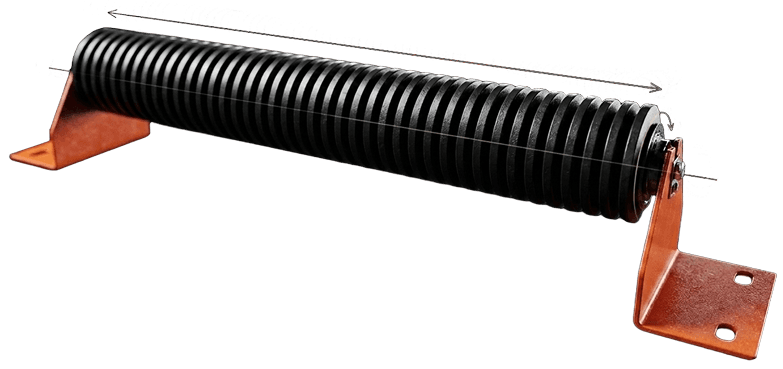

Fluent supplies CEMA-rated flat idlers, individual replacement rollers, and full idler assemblies for our conveyors and general replacement. Our engineering team can confirm part fit from a serial number, approval drawing, or dimensional data.
Standard replacement idlers ship in 2–5 weeks. Contact us with your specs for current availability.
Ready to work with the experts?
OSHA. "The control of hazardous energy (lockout/tagout)." 29 CFR 1910.147. https://www.osha.gov/laws-regs/regulations/standardnumber/1910/1910.147
OSHA. "Conveyors." 29 CFR 1926.555.
https://www.osha.gov/laws-regs/regulations/standardnumber/1926/1926.555
PPI. "Conveyor idler storage, installation and operation manual." PPI Global. https://www.ppi-global.com/userdocs/literature/ppi/documents/idler_o_m_manual_ppi_update.pdf