








Copyright © 2026 Fluent Conveyors, LLC. All rights reserved.
The Fluent Conveyors logo is a registered trademark of Fluent Conveyors, LLC. Serial Number 97664258 Registered on Dec. 12, 2023


Copyright © 2026 Fluent Conveyors, LLC. All rights reserved.
The Fluent Conveyors logo is a registered trademark of Fluent Conveyors, LLC. Serial Number 97664258 Registered on Dec. 12, 2023

OSHA writes and enforces workplace safety regulations that carry the force of law. It does not certify conveyors, approve equipment, or endorse individual safety devices, so there is no such thing as an OSHA-certified conveyor. Applicable rules depend on the workplace where the conveyor operates. Fluent builds guarding, stop devices, isolation points, and maintenance access into the equipment. Workplaces are responsible for compliance. Our conveyor standards overview covers the consensus standards that sit alongside OSHA regulations.

A conveyor may be engineered to a consensus standard such as ISO 12100 or its domestic equivalents. OSHA regulations define a specific workplace and the conditions in which the equipment is installed and operated.
A vendor claiming OSHA certification for equipment is describing something that does not exist. The more useful question is whether the manufacturer can identify the hazards created by the machine and show how each one was addressed. See our page on evaluating conveyor manufacturers for more details.
A conveyor system can leave the factory built to every requirement in the purchase order and still become part of a noncompliant installation. Guarding left off during commissioning, a lockout procedure that was never written, or a walkway added after startup can change the compliance picture without changing the original machine.
Employer duties dominate because OSHA's rules are directed primarily at the employer. Training, inspection frequency, written energy-control procedures, and day-to-day enforcement are employer responsibilities even when the supplier provides the hardware that supports them. Our conveyor safety guides cover what those programs look like in practice.
Fluent's scope has two important limits. Fluent is responsible for the equipment it supplies, not for hazards created by adjacent machines or by the sequencing of an entire line it did not design. Operating a conveyor outside its rated capacity or with required guarding removed also falls outside our warranty coverage.
The same conveyor can fall under different OSHA rules depending on where it is used. Workplace classification comes first.
Roughly half the states operate their own OSHA plans for private-sector employers. Those plans must be at least as effective as the federal program and may impose stricter requirements. A conveyor acceptable under the federal rules may need additional provisions in a state-plan jurisdiction. Send the facility location with the RFQ; the RFQ writing guide lists the other information that belongs in the package.
The general duty clause also matters. It can apply to recognized hazards that are not addressed by a more specific OSHA regulation, including hazards around conveyors that do not fit under one numbered rule.
The machine-guarding and power-transmission rules can apply to different parts of the same hazard. The general guarding rule addresses points where moving machinery can contact a person. The power-transmission rule addresses drive components such as pulleys, belts, chains, sprockets, shafting, and couplings.
OSHA guarding rules apply regardless of which consensus standard was used during conveyor design. A conveyor built to a current safety standard still has to meet OSHA guarding requirements as installed. Detailed guidance on openings, coverage, and reach distances appears on our page covering OSHA conveyor guarding requirements; this page focuses on the regulatory framework and responsibility.
The OSHA construction conveyor rule incorporates ANSI B20.1-1957 by reference. When a regulation incorporates a standard by reference, it locks in the edition named at the time. The rule has not since been updated to a newer edition.
The current consensus standard is ASME B20.1. It addresses conveyor design, construction, installation, maintenance, inspection, and operation as they relate to hazards and has been revised many times since 1957.
Both references are correct. The OSHA construction rule enforces the edition it incorporated, while a modern purchase specification may cite the current ASME edition. That difference comes from how incorporation by reference works, not from a contradiction between the two documents. Our CEMA conveyor standards page covers other domestic conveyor standards that are widely used.
Fluent builds to the current edition of the conveyor safety standard, which meets or exceeds the incorporated 1957 edition. See related coverage on our ANSI and ASME conveyor standards page.
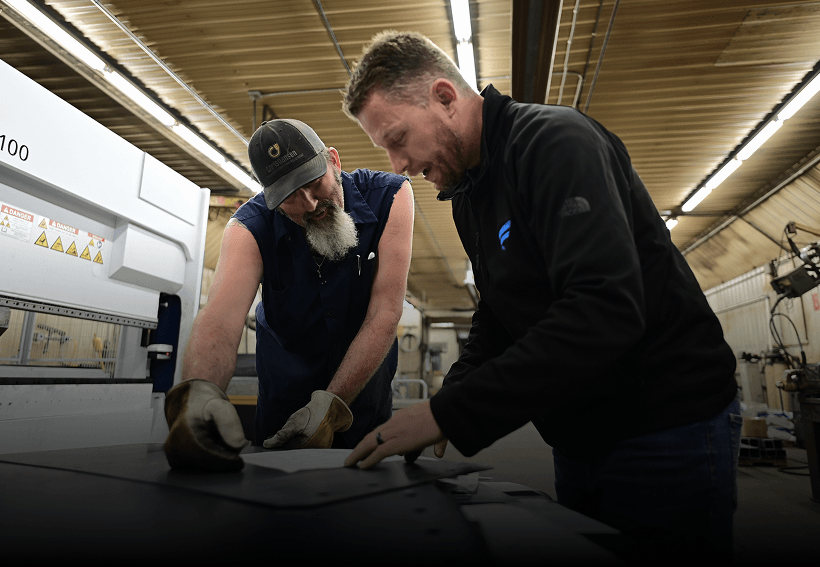
Regulatory requirements eventually translate into dimensions, component selections, and control logic on the engineering drawings.
Drive type changes where hazards appear. On sprocket-driven conveyors, the main pinch and shear points occur around chain and sprocket engagement at the head and tail, the return chain run, cleats and flights, and oiler access.
On a pulley-driven machine, the primary hazards shift to head and tail pulley nips, snub and bend pulley nips, and belt-to-idler pinch points. Guarding designed for one drive type does not work for the other.
Labels are another output of the hazard review. CEMA safety labels using the ANSI Z535 sign format are placed according to specific identified hazards. Labels support the employer's hazard communication program. They do not replace a site-specific assessment of the installed machine.
Control-system requirements are handled separately. The reliability of a stop function under fault is also a separate topic. Where a project specifies a required performance level, that is addressed under ISO 13849-1.

Applicable standards and customer requirements
Application and hazard review
Mechanical and controls engineering
Drawing and manufacturability review
Fabrication and assembly controls
Guarding and safety device verification
Operational testing and QA records
Manuals, drawings, customer handoff
Installation, commissioning, and employer procedures

Records the facility location and workplace classification, the buyer's internal EHS requirements, controls scope, and who will assemble the finished line. Engineering then works in 3D CAD from material, bulk density, throughput, incline, and operating environment. On a custom conveyor, that allows guarding and maintenance access to be resolved before fabrication.
Produces a written hazard review retained with the build record and available to the customer on request. The method behind that review is described on our ISO 12100 risk assessment page. Stages 3 through 6 turn the review into physical geometry and hardware. Guards, stop devices, and safety labels are installed during assembly.
involves running each assembled conveyor for more than 10 hours while speed, tracking, alignment, noise, safety stops, and electrical function are checked. Our conveyor quality assurance page covers what is recorded and what documentation is available afterward.
Move the remaining responsibilities into the handoff documentation. That includes guarding requirements, inspection intervals, and risks the design could not eliminate. The employer uses those records to build its own operating, training, and maintenance program. On engineered projects, the required build records are defined under quality, safety, and regulatory compliance.
A mechanically compatible replacement part is not automatically a safety-equivalent part. The question is whether the conveyor still operates within the hazard controls and energy-control assumptions built into the original design.
Replacing a guard with a different panel design is an engineering decision because opening size and distance from the hazard are part of the safety function. Replacing a safety device verifies only the component, not the stop function it belongs to, which is why the circuit logic falls outside a typical replacement order. A drive change that alters speed or coast-down distance can also move the machine outside the operating conditions assumed in the original hazard review.
Belt substitutions create similar issues. A belt can fit the frame and still fail a facility requirement for flame retardance, static dissipation, or chemical resistance. Those properties come from the belt manufacturer's testing. Our replacement belts are quoted against application requirements.
For Fluent-built equipment, the build record is on file, so a candidate part can be checked against the requirements the machine was engineered to. Send the serial number, the part being replaced, the candidate data sheet, and current operating conditions. Our service and support team routes the review.
Retrofits follow the same principle on a larger scale. Increasing capacity, adding a discharge, changing control behavior, or modifying access shift compliance responsibility toward the party making the change.
Conveyor citations tend to cluster around a small number of recurring hazards, many involving components also covered in our maintenance guides.
The common issue is the interface between a moving component and a person who needs to work near it. Many conveyor hazards are access problems, which is why maintenance geometry should be resolved during engineering. See reducing conveyor hazards for practical advice.
No document supplied with a conveyor creates OSHA compliance. These records support the employer's own compliance program, including the hazard register, energy-control procedures, training materials, and inspection schedule. See the roller chain conveyor owner's manual for an example.

Send the conveyor type, site address and workplace classification, material and throughput, cleaning and access requirements, controls scope, and internal EHS specification. We’ll design a conveyor that fits your regulatory and application requirements.