









Copyright © 2026 Fluent Conveyors, LLC. All rights reserved.

The Fluent Conveyors logo is a registered trademark of Fluent Conveyors, LLC. Serial Number 97664258 Registered on Dec. 12, 2023


Copyright © 2026 Fluent Conveyors, LLC. All rights reserved.
The Fluent Conveyors logo is a registered trademark of Fluent Conveyors, LLC. Serial Number 97664258 Registered on Dec. 12, 2023
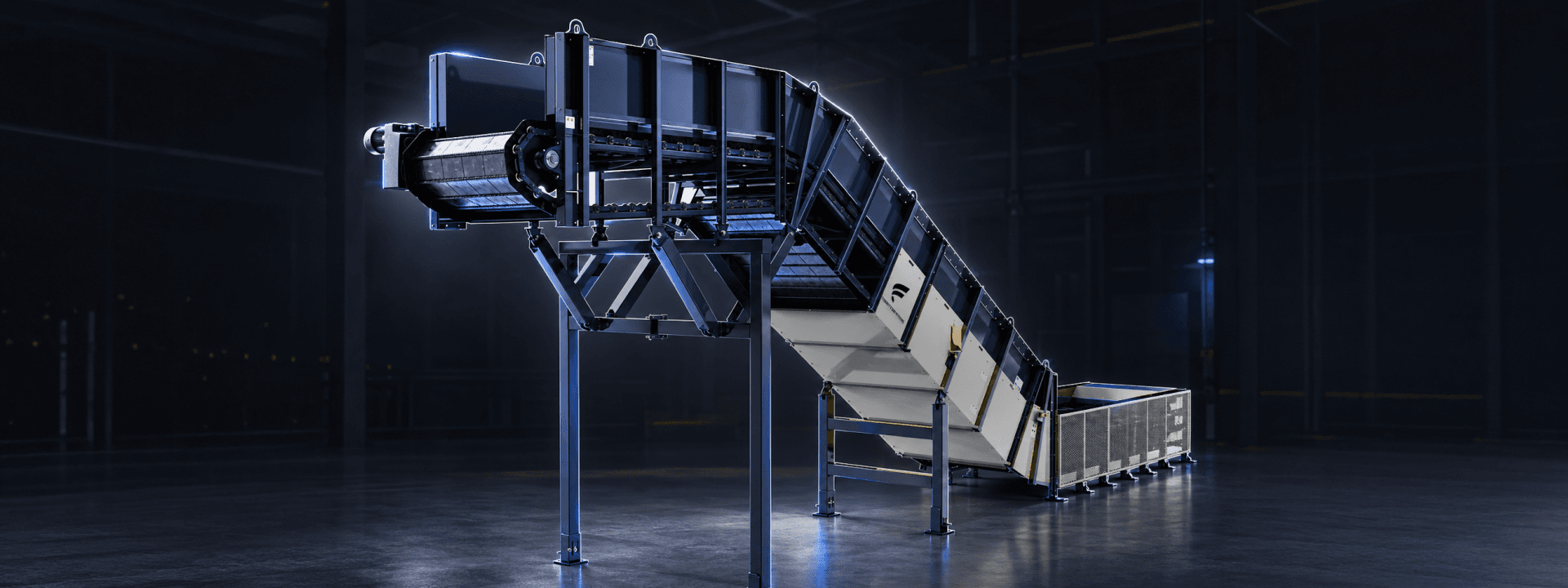
Industrial conveyors are mechanical systems that continuously move bulk and unit loads for manufacturing, recycling, mining, logistics, and waste-handling operations. They run on rugged drives, frames, and load-bearing surfaces engineered for heavy material, high duty cycles, and harsh environments.

A conveyor could be anything from a grocery store checkout belt to a mile-long mining system. Industrial conveyors occupy the heavy end of that spectrum, and the dividing line is construction.
A light-duty plastic modular belt conveyor in a beverage bottling line and a heavy-duty roller chain conveyor feeding a baler at a scrap yard are both conveyors, but only one of them survives a year of contact with sharp metal at 110°F.
Industrial conveyors convert rotational energy from a motor into linear motion of a load-bearing surface that carries material from a feed point to a discharge point along a defined path.
The drive arrangement is what most distinguishes conveyor types from one another. Two arrangements dominate industrial material handling:
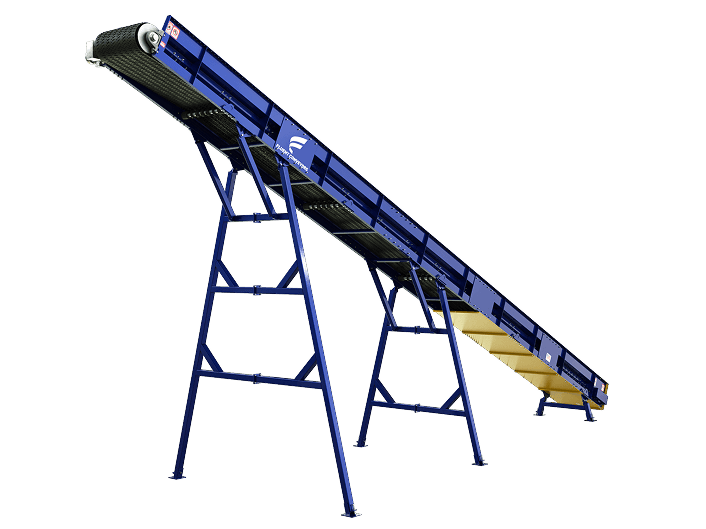

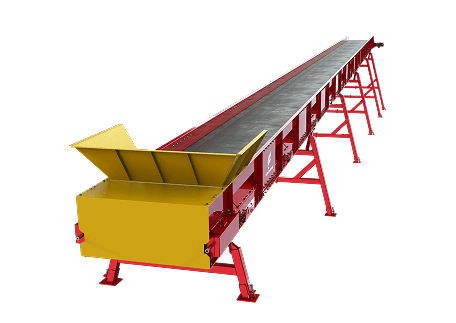
Use a head pulley and tail pulley to drive and tension a continuous rubber belt. Idlers or a slider bed support the carry side of the belt; return idlers support the bottom side. This is the most common drive configuration.
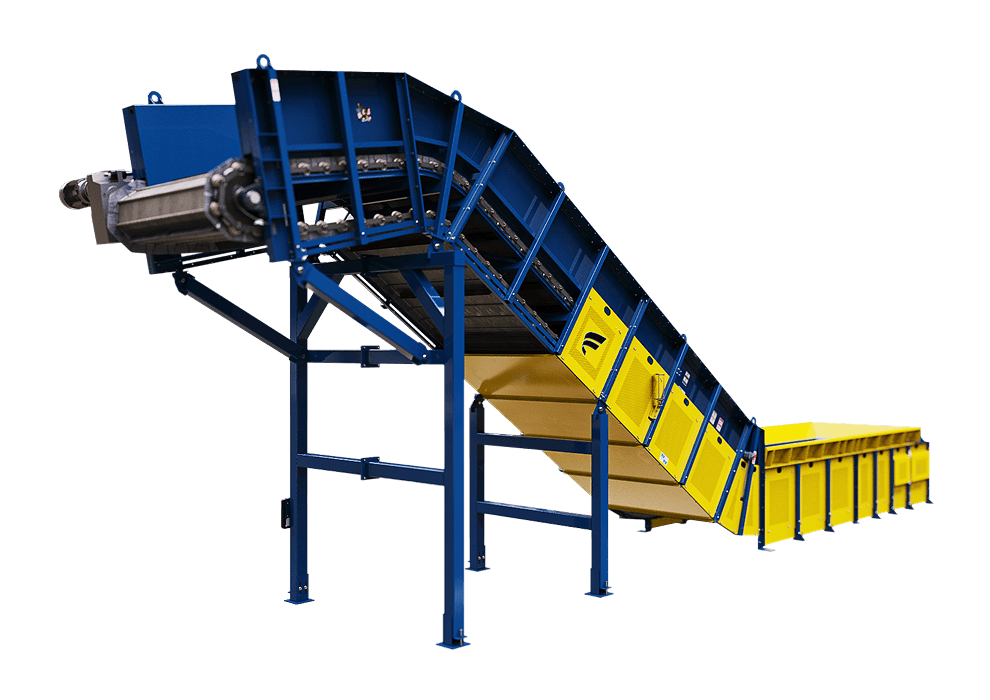
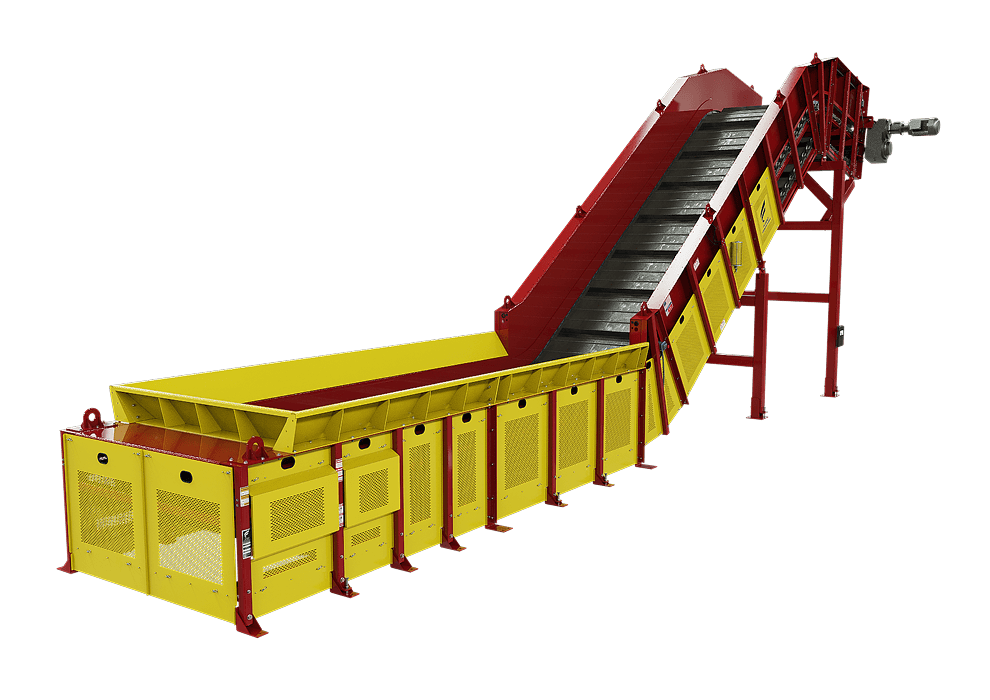
Use a roller chain engaged by drive sprockets, with steel pans, slats, hinged steel plates, or rubber combo belting attached to the chain. The chain transmits power through positive mechanical engagement, which means no slippage and far higher torque capacity than pulley-driven systems. Sprocket-driven conveyors handle the loads that destroy pulley-driven belts.
Industrial conveyors run at speeds between 30 and 600 feet per minute. High-torque applications (baler infeed, scrap, demolition) run at slower speeds. Package handling and sortation run faster. Throughput depends on belt width, conveyor speed, fill factor, and material density. Bulk applications are measured in tons per hour; unit handling in pieces per hour.
Handle loose, flowable material, such as:
Aggregates
Organic waste
Ore
Grain
Coal
Recycled fibers
Shredded material
Material is loaded onto a continuous surface and discharged at the end of the run. Trough idler conveyors and roller chain conveyors with pan or rubber belts are the standard solutions for bulk material handling in heavy industry. Belt width, trough angle, and material density set the throughput ceiling.
Handle discrete items, such as:
Cartons
Totes
Parcels
Pallets
Assemblies
Finished goods.
Slider bed, flat idler, and powered roller conveyors are the standard solutions. Throughput is measured in pieces per hour, and accumulation, sortation, and orientation often matter as much as raw conveying speed.
Many facilities run both. A material recovery facility might use roller chain conveyors for infeed and at the sort station, then transition to trough or flat idler conveyors to move sorted materials.
The category covers a wide range of equipment. A handful of types account for most heavy-industrial deployments; the rest serve narrower niches.

If you run a facility that handles material at scale and you've never specified an industrial conveyor before, the path forward is simple. You don't need to know which type you want when you reach out. You need to be able to describe what you're moving, how much of it, and where it needs to go. We work back from those answers to the design.
Fluent designs and manufactures custom conveyors for every major industrial sector, from a single replacement unit to a fully integrated processing line. Every system is built in the USA, engineered to ASTM A36 frame standards with grade 8 hardware and L10-rated bearings, and matched to the duty cycle, throughput, and environment of the application.
If your operation is new to conveyors, we'll walk you through the variables that drive selection. If you're replacing or expanding an existing system, we can evaluate the current setup and design around it.