









Copyright © 2026 Fluent Conveyors, LLC. All rights reserved.

The Fluent Conveyors logo is a registered trademark of Fluent Conveyors, LLC. Serial Number 97664258 Registered on Dec. 12, 2023


Copyright © 2026 Fluent Conveyors, LLC. All rights reserved.
The Fluent Conveyors logo is a registered trademark of Fluent Conveyors, LLC. Serial Number 97664258 Registered on Dec. 12, 2023
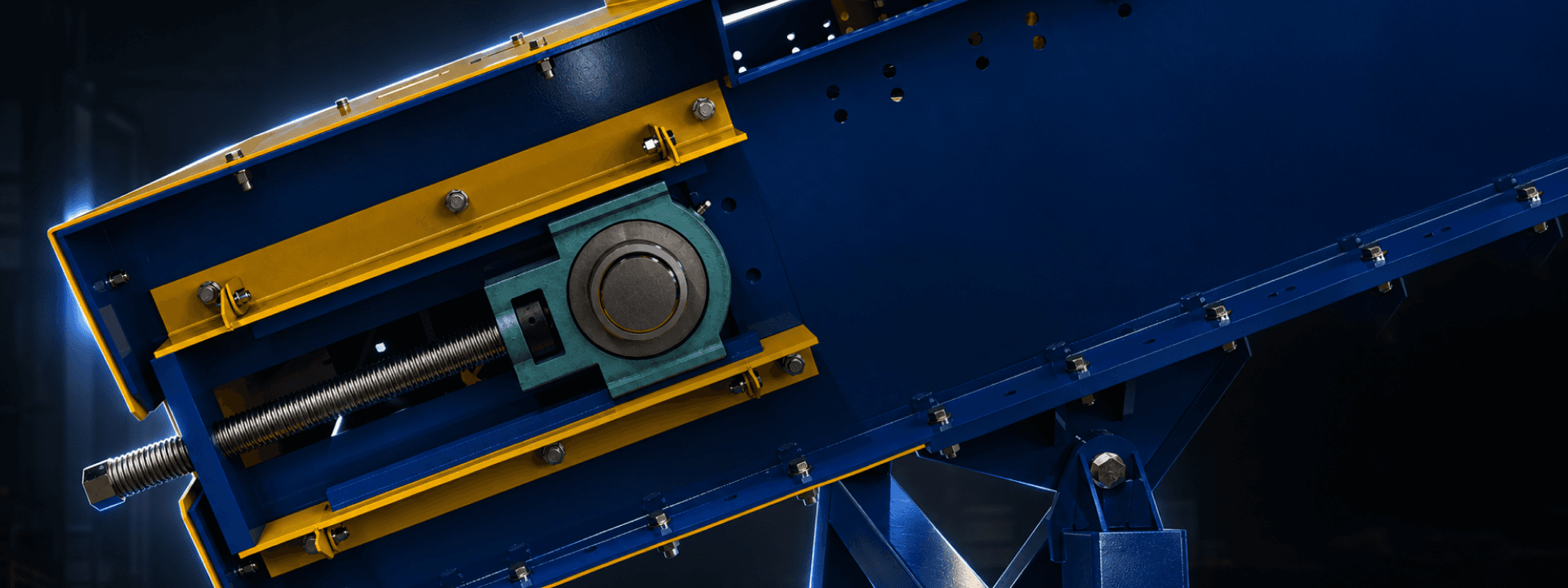
Unplanned downtime costs industrial manufacturers an average of $260,000 per hour, and a failed take-up assembly is one of the failure modes most likely to stop a heavy-duty conveyor cold.

The take-up assembly controls belt tension, holds the tail pulley in alignment, and absorbs belt stretch over service life. As part of a routine replacement schedule or after failure, a heavy-duty take-up assembly should be replaced following these general steps:
Most heavy-duty take-up replacements are mechanically straightforward once the part is dimensionally matched.
Below, we cover screw-type assemblies, with a dedicated section on hydraulic-assisted variants. We'll walk through how to decide whether replacement is the right call, the dimensions to record before ordering, the full step-by-step procedure, the simultaneous-adjustment rule that protects belt life, and the post-install checks that confirm the repair is complete.
Replace the assembly when the structural or mechanical components can no longer hold tension, hold alignment, or move through their full travel. Inspect adjacent components at the same time. The tail pulley, shaft, and surrounding conveyor frame often show wear that explains why the assembly failed in the first place. The most common replacement triggers:
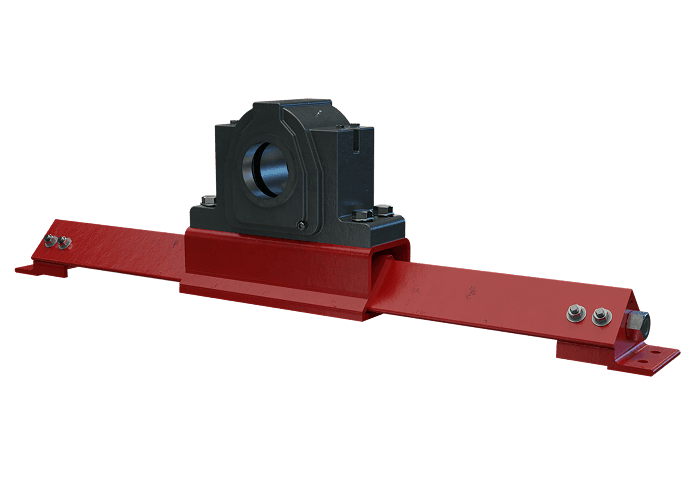
A seized take-up screw is the most common failure point on hydraulic-assisted assemblies, and a cracked frame or saddle is the most common point on manual screw assemblies in abrasive recycling environments.
Not every take-up problem requires a full assembly replacement. Some take-up problems are solvable through system adjustments or minor component replacement.
Heavy-duty take-up frames are designed as serviceable assemblies. Bearings, screws, saddles, and stop nuts are usually field-replaceable without removing the frame itself, and adjacent components (the tail pulley, bearings, and splice kit at the connected belt section) should be inspected at the same time. Reserve full assembly replacement for structural damage or end-of-life corrosion.
If you've isolated the failure to the bearing, you can likely replace the bearing instead of the take-up assembly. See how to replace a pillow block bearing for steps.
Lockout/tagout is mandatory before any contact with the take-up assembly, belt, or frame. OSHA 29 CFR 1910.147 covers all servicing where unexpected startup or release of stored energy can cause injury; take-up assemblies store significant energy in the form of belt tension.
Before starting:
Stop the conveyor.
Follow your site's LOTO procedure and isolate all energy sources.
For hydraulic-assisted assemblies, isolate hydraulic supply and bleed system pressure per site procedure.
On inclined conveyors with a loaded belt, account for the stored energy of the load before releasing tension.
Confirm zero-energy state before removing guards or touching any hardware.
Heavy-duty take-up assemblies in the 36-inch-and-wider belt-width range typically require mechanical lifting support during removal and installation. Plan rigging and lifting equipment before the assembly comes apart, and confirm the guard configuration before restart. Only trained maintenance personnel should perform this work.


The following sequence applies to screw and hydraulic-assisted screw assemblies. Adapt each step to your hardware; saddle styles, retention methods, and hydraulic configurations vary between manufacturers.

Follow your site's LOTO procedure. For hydraulic-assisted systems, isolate and bleed hydraulic supply pressure. No work proceeds until a zero-energy state is confirmed.
Before any tension is released, measure and record the distance from a fixed frame reference to the take-up frame on both sides. Photograph the assembly from multiple angles. This baseline tells you where the take-up was operating before failure and gives you a starting point for post-install tensioning.
For manual screw assemblies, back off the adjustment screws alternating one full turn at a time on each side until the conveyor belt goes slack. Never advance one screw more than one full turn ahead of the other; this “simultaneous-adjustment rule” protects belt tracking and prevents frame distortion, and it applies during tension release and tensioning alike. For hydraulic-assisted assemblies, run both cylinders to full pressure first to transfer load off the screws, then back off the screws on both sides to open clearance.
Position belt supports on either side of the take-up zone. Support the tail pulley before any bearing or shaft hardware is removed.
Remove fixed guards and nip guards covering the take-up area. Set hardware aside and note where each piece came from.
Cap or plug hydraulic lines to prevent contamination. Label each line for proper reconnection. Bleed any residual pressure before disconnecting.
With the pulley supported, remove the bearing-to-shaft retention hardware (set screws, keys, or locking collars) and slide the shaft out of the bearings. Inspect the shaft and pulley for wear, scoring, or lagging deterioration before setting aside for reinstallation or replacement.
Unbolt the bearings from the saddles. Inspect bearing condition for signs of wear or failure. Remove adjustment screws, stop nuts, and saddle hardware in order.
Unbolt the frame from the conveyor structure. Use lifting equipment to hoist the assembly out of the conveyor frame.
With the frame out, inspect:
Conveyor frame mounting points for cracks, deformation, or elongated bolt holes
Belt surface in the take-up zone for damage from a running misaligned pulley or worn bearing
Shaft seats on the tail pulley if it's being reinstalled
Adjacent bearings, drive components, and belt scrapers for wear that should be addressed in the same window
Position the new frame on the conveyor structure. Verify the frame is square to the conveyor centerline and level across the belt width before torquing mounting bolts. An out-of-square take-up frame will de-train the belt, no matter how carefully the rest of the procedure is performed.
Mount the bearings to the saddles. Install adjustment screws, stop nuts, and saddle components per the manufacturer's configuration. Torque all hardware to specification.
Slide the pulley shaft through the bearings. Secure the shaft using set screws, keys, or a locking collar. Verify the pulley is centered on the belt path.
Reconnect lines per labeling, bleed air from each cylinder, and pressure-test before belt installation.
With the belt routed around the tail pulley, advance both adjustment screws, alternating one full turn at a time, until the belt begins to show light tension. Never turn one screw more than one full turn ahead of the other. This prevents uneven tension across the belt width, prevents frame distortion, and protects belt tracking. For hydraulic-assisted systems, use the cylinders to assist initial tensioning; the simultaneous-side rule still applies to the screws.
Fine-tensioning follows the manufacturer's tension calculation. Belt sag between idlers, drive pulley slip, and bearing temperature are the primary indicators of correct tension.
Measure diagonal distances from the head pulley to the tail pulley on both sides of the conveyor. The diagonals should be equal within tolerance. If they're not, the take-up needs equal-side adjustment to square the belt path before final tensioning.
All guards removed for access must be reinstalled before restart.
Start the conveyor unloaded and observe belt tracking through at least two full revolutions. Confirm that the new bearings run cool, the belt doesn't drift toward either frame edge, and there is no rubbing, squealing, or vibration. Run under light load before returning to normal operation.
If tracking problems persist after replacement, the most likely causes are frame squareness, unequal side travel, or a pre-existing belt issue that the failing take-up was masking.
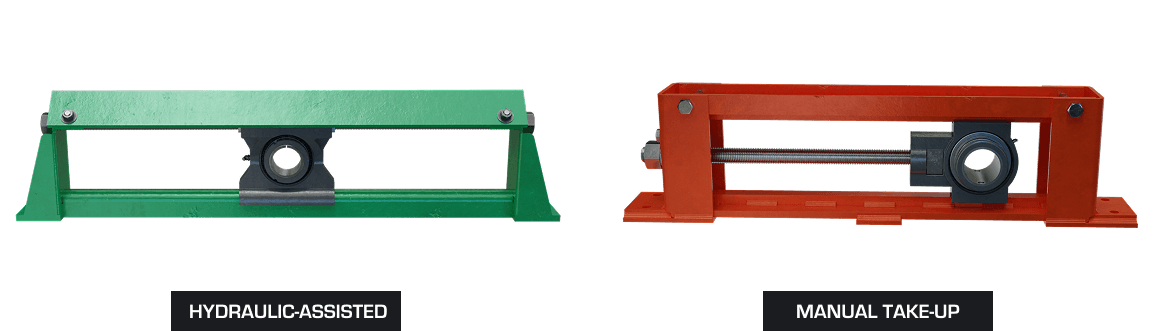
Hydraulic-assisted screw take-ups combine manual screw adjustment with a hydraulic cylinder that transfers belt-tension load off the adjustment screws during service. These are common on long heavy-duty conveyors and on systems where belt tension is too high to release safely by backing off screws alone.
Replacement is mechanically similar to manual screw assemblies, with three differences:
Tension is released hydraulically first. Both cylinders are run to full pressure, which transfers load from the screws onto the cylinders. Then, the adjustment screws are turned to open the clearance between the stop nut and saddle. Releasing screws on a fully loaded hydraulic assembly without first energizing the cylinders can damage threads and is unsafe.
Hydraulic lines must be capped and labeled before disconnecting. Contamination of hydraulic fluid is the leading cause of cylinder seal failure after service. Cap fittings immediately, label lines for reconnection, and protect them through the rest of the procedure.
The system must be bled and pressure-tested before belt installation. Air in the cylinders causes uneven side movement during tensioning, which is the condition the simultaneous-adjustment rule exists to prevent.
If you're unsure whether your assembly is hydraulic-assisted, look for a hydraulic cylinder mounted parallel to or in line with the adjustment screw on each side of the frame, and a hydraulic line running from each cylinder to a manifold or pump.
A part number stamped on the frame or in the original conveyor documentation is the fastest path to a matched replacement. If that isn't available, collect the following before the assembly is removed.
Photograph the assembly from multiple angles before disassembly. Document the current take-up position by measuring from a fixed reference point on the conveyor frame to a corresponding point on the take-up frame, both sides. This becomes the baseline for post-install tensioning.
If your conveyor was built by Fluent, contact our parts team with the conveyor serial number, and we'll pull the original build details, including frame style, bearing spec, and pulley dimensions.
● Belt width
● Frame style (top mount, side mount, wide slot, narrow slot)
● Duty rating
● Take-up travel (the full stroke distance)
● Mounting hole pattern and bolt spacing
● Bearing type (ball, spherical roller, or sleeve). Heavy-duty assemblies typically use spherical roller bearings for their self-aligning capability and higher load rating. See take-up bearings for housing, seal, and material variations.
● Shaft diameter at the bearing
● Bolt pattern (2-bolt or 4-bolt)
● Seal type and environment rating
● Adjustment screw thread (ACME is standard on heavy-duty assemblies) and length
● Stop nut style
● Saddle configuration
● Tail pulley diameter, face width, shaft diameter, and lagging

Fluent designs and manufactures custom conveyors for recycling, waste management, scrap handling, and other demanding industries. The heavy-duty take-up assemblies, bearings, and pulleys we stock are the same components we specify in our own systems, chosen for exceptional field performance.
Heavy-duty take-up frames in screw and hydraulic-assisted configurations
Take-up bearings in ball, spherical roller, and sleeve types with seal options for harsh environments
Replacement tail pulleys matched to frame, shaft, and belt width
Approval drawings available to validate non-Fluent specifications before order placement
Lead time 2–4 weeks
Ready to work with the experts?
