








Copyright © 2026 Fluent Conveyors, LLC. All rights reserved.
The Fluent Conveyors logo is a registered trademark of Fluent Conveyors, LLC. Serial Number 97664258 Registered on Dec. 12, 2023


Copyright © 2026 Fluent Conveyors, LLC. All rights reserved.
The Fluent Conveyors logo is a registered trademark of Fluent Conveyors, LLC. Serial Number 97664258 Registered on Dec. 12, 2023
OSHA's construction rule for conveyors incorporates ANSI B20.1-1957. The current consensus edition is ASME B20.1. We build to the current edition, and to the wider set of ANSI and ASME standards governing chain, sprockets, guarding, and labeling.



Accredits the organizations that write standards, oversees their procedures for consensus and due process, and approves finished documents as American National Standards. Roughly 240 accredited developers work under that framework. ANSI authors none of the standards itself.
Writes and publishes the documents. The B20 committee owns the conveyor safety standard, and the B29 committee owns the chain and sprocket standards.
When a specification reads ANSI/ASME B20.1, ASME authored the document, and ANSI approved it through the consensus process. Neither body certifies conveyors: ANSI is not a product certifier, tester, or laboratory, and ASME issues no conformity mark for conveying equipment. Fluent states the standards it builds to and what records substantiate the claim. See our standards page for more information.
Safety provisions, chain geometry, guarding criteria, and label content are discussed in several documents. We draw on all of them to build our conveyors.
B20.1 is the most important document. It covers bulk material, package, and unit handling conveyors across permanent, temporary, and portable installations, and its general safety provisions carry guarding, emergency stopping, startup warning, headroom, transfer and discharge point protection, hoppers and chutes, and risk reduction. See our ASME B20.1-2024 conveyor safety standard page for scope exclusions, requirement categories, and edition changes.
Adjacent documents come into scope by application. CEMA standards govern capacity, idler and pulley classification, and component load ratings. Panel construction follows UL 508A and, for relevant markets, TÜV.
The B29 series applies to multiple components and systems on our roller chain conveyors. B29.15M covers steel roller-type conveyor chains, attachments, and sprocket teeth, fixing the dimensions that determine whether parts from different sources interchange.
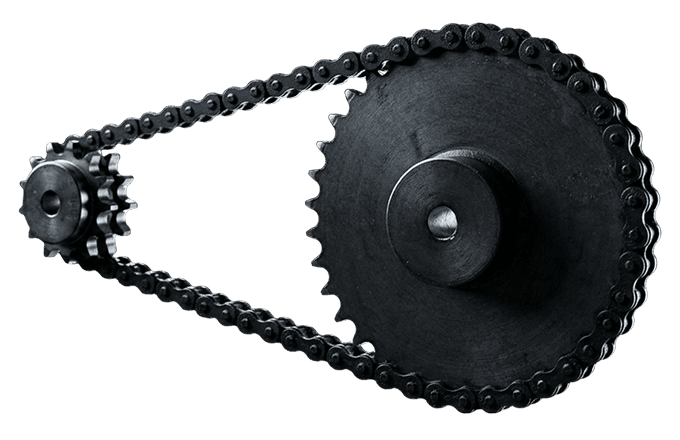
We manufacture our own sprockets, so those tooth-form and runout limits are a production tolerance on our floor. Cutting to the published geometry allows customers to order a replacement sprocket years later and have it mesh with chain already in service. See our published sprocket dimensions.
The same logic governs the chain side. Specifying to a recognized class means replacement roller chain in a standard pitch drops into an existing belt without a redesign, and a strand from one supplier articulates correctly on sprockets from another. Drive chain between the reducer and the headshaft falls under B29.1 instead, and longer-pitch conveying applications fall under B29.100.
Compliance is a sequence of controlled steps rather than a review at the end.
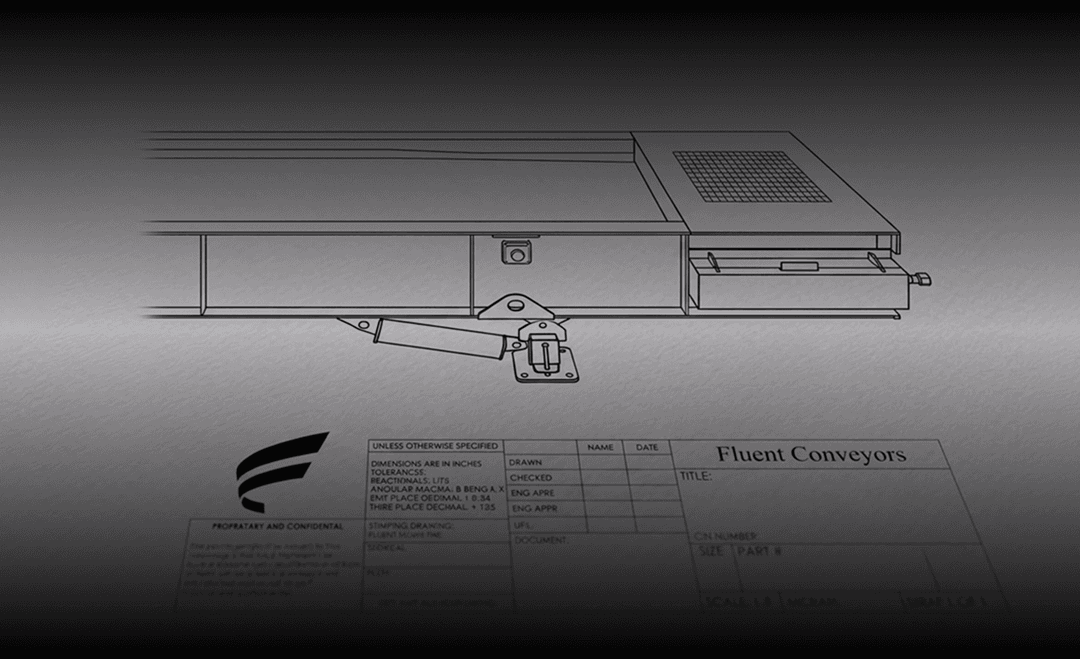
Engineering works in 3D CAD from data regarding material, bulk density, throughput, incline, operating environment, and any facility or EHS specification supplied with the RFQ. Guarding strategy, emergency stop placement, access zones, and control behavior are determined at this stage.
Fabrication controls follow the released drawings. Guards, safety devices, and labels are installed as part of assembly rather than added afterward.
Each conveyor is fully assembled and run for more than 10 hours while we check speed, tracking, alignment, noise, safety stops, and electrical function. Our conveyor quality assurance page sequences the inspection points, and control panels are certified separately against panel construction requirements.
A compliant machine can become a noncompliant installation. Understand how different parties fit into the larger compliance picture.
Scope boundaries also shape what our obligation covers. Running a machine outside its rated capacity or with guarding removed, for example, sits outside the warranty coverage terms.
Reference manuals are published, including the roller chain conveyor owner's manual and the wider specifications and owner's manuals library. On engineered projects, documentation and reporting expectations are set out under quality, safety, and regulatory compliance.

Standards requirements get priced into your conveyor quote. Send your conveyor type, facility location, material, operating conditions, controls scope, and internal safety specification, and our engineering team will identify which provisions apply to the project.
