





Copyright © 2026 Fluent Conveyors, LLC. All rights reserved.

The Fluent Conveyors logo is a registered trademark of Fluent Conveyors, LLC. Serial Number 97664258 Registered on Dec. 12, 2023


Copyright © 2026 Fluent Conveyors, LLC. All rights reserved.
The Fluent Conveyors logo is a registered trademark of Fluent Conveyors, LLC. Serial Number 97664258 Registered on Dec. 12, 2023

A fabric conveyor belt is reinforced with one or more layers of woven textile, usually polyester and nylon. The fabric carries belt tension, while rubber or PVC covers protect it from the material and conveyor components. Belt layers wear at different rates, so a belt may look sound on the surface even as the fabric inside loses strength. Learn how fabric belts are constructed, used, and specified.

Fabric refers to the woven textile reinforcement inside the belt, known as the carcass. The visible surface is usually rubber, PVC, urethane, or silicone. A black rubber belt on a trough idler conveyor and a PVC belt on a package line can both be fabric belts. Outside of steel cord construction, a rubber conveyor belt almost always uses a fabric carcass.
A fabric belt may have a single ply, several stacked plies, or one solid woven carcass. Cover construction varies as well. Many belts have rubber on both faces, while a slider bed belt may use bare or impregnated fabric on the underside to reduce friction against the bed.
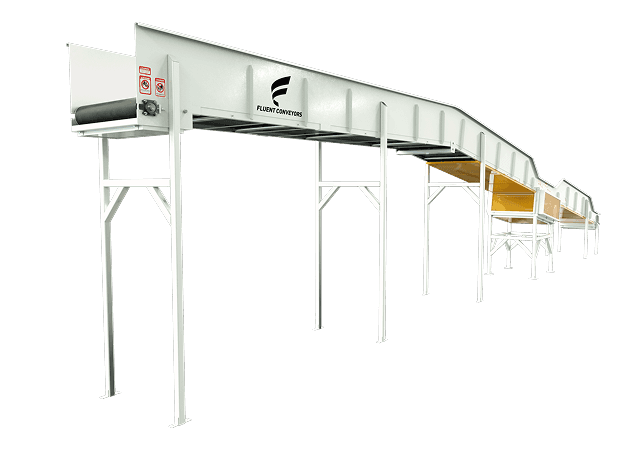
The belt and the complete machine also have similar names. A fabric conveyor belt is the moving belt itself. A fabric belt conveyor is the entire machine, including the frame, pulleys, drive, and the idlers or bed supporting the belt.
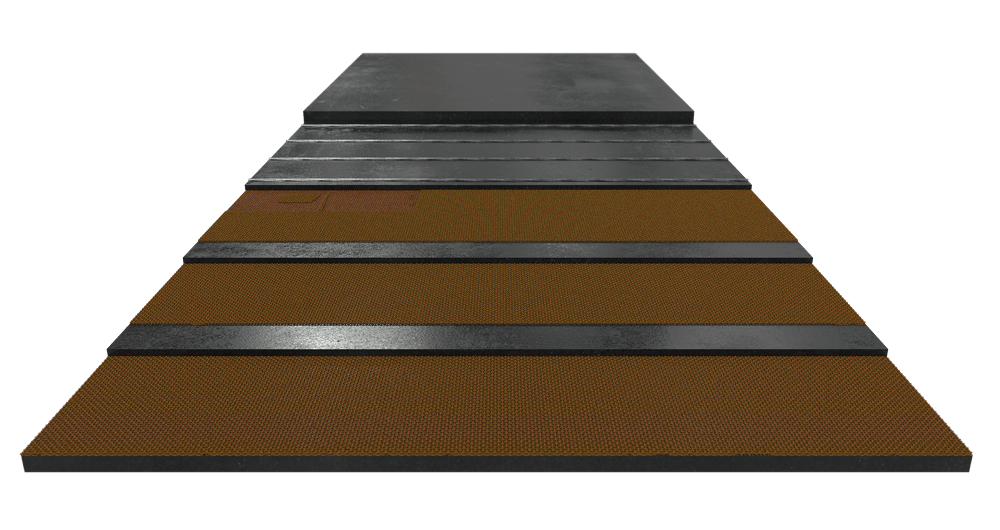
On any belt conveyor, the drive pulley pulls the belt, and that force travels through the carcass from end to end. Lengthwise warp yarns carry the tension. Crosswise weft yarns hold the belt together across its width, allow it to form a trough, and provide support for mechanical fasteners. The covers separate the fabric from the material and machine components that contact the belt.
Fiber choice affects how much the carcass stretches. In one test of three-ply belts rated 800 N/mm, nylon carcasses stretched 1.52% at their reference load, while polyester-nylon (EP) carcasses stretched 1.06%, according to a 2020 study. That additional stretch uses more travel in the take-up over the life of the belt.
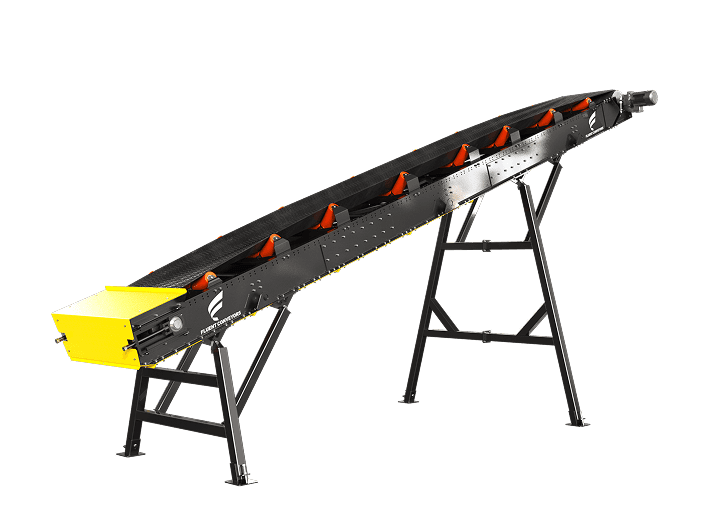
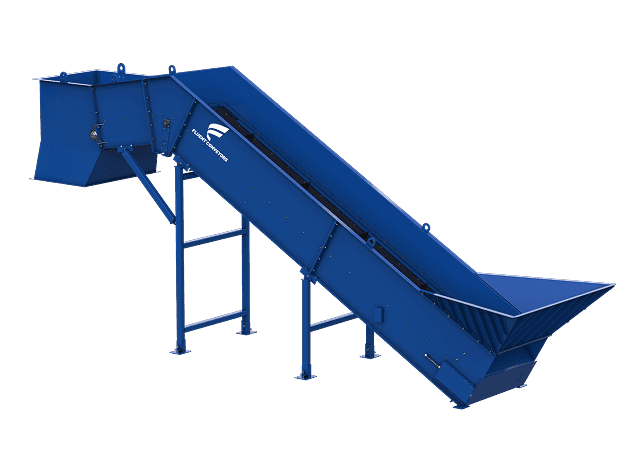
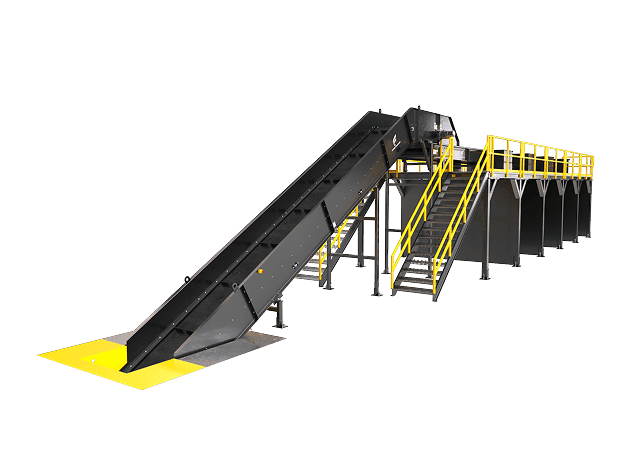
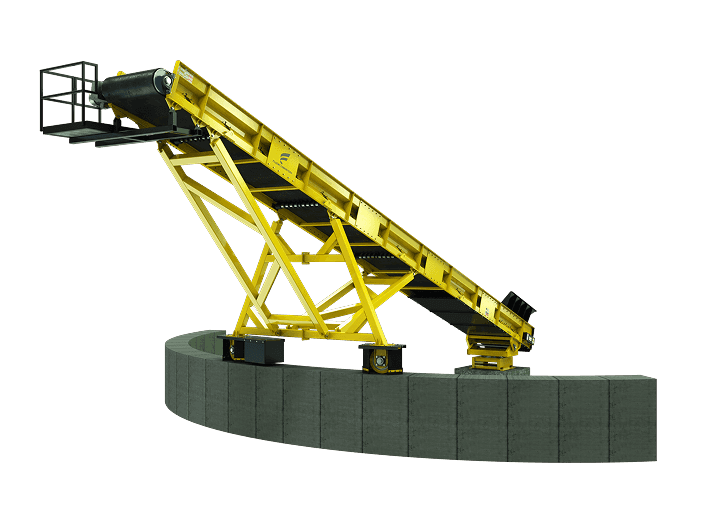
Fabric belts run on pulley-driven conveyors ranging from heavy bulk systems to light package lines. On the equipment we build and supply, common applications include:
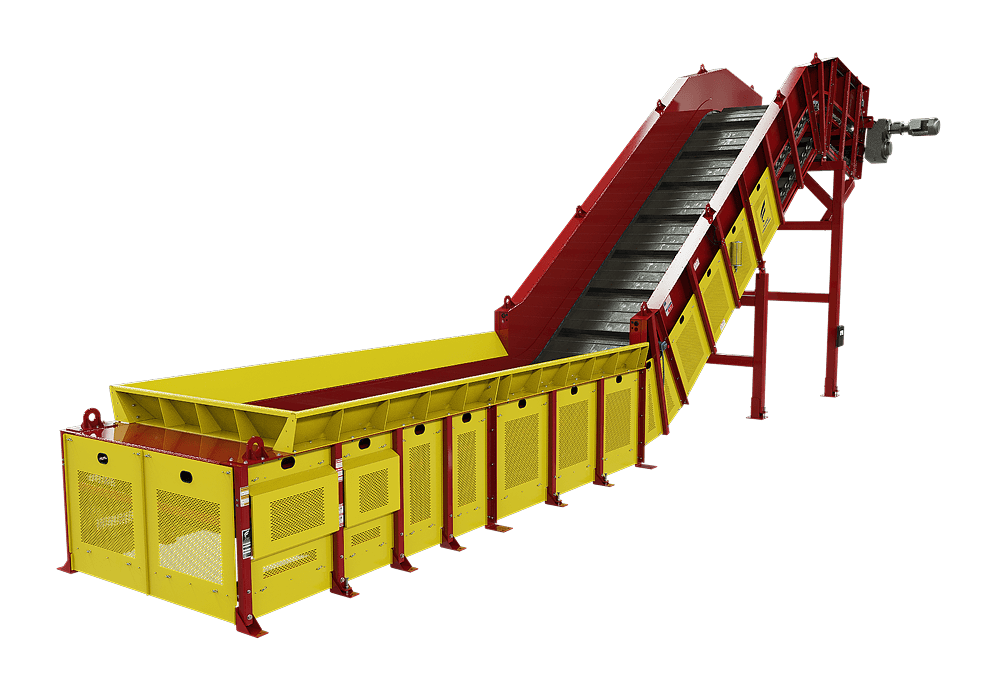
Rubber combination belts bolt 2-ply or 3-ply fabric belting to steel channels. The chains carry the pull, while the belting contains fines and wet fiber.
Rubber combination belts bolt 2-ply or 3-ply fabric belting to steel channels. The chains carry the pull, while the belting contains fines and wet fiber.
The covers and carcass do not deteriorate at the same rate. A 2022 study from Wroclaw University of Science and Technology tested two 63-inch (1,600 mm), five-ply nylon belts from a Polish lignite mine when new and again after service. Belt A-10 ran for about 6.2 years and carried roughly 11.4 million US tons. Belt B-07 ran for 3 years and carried about 4.7 million US tons.
The cover rubber lost about 40% of its tensile strength and became harder, while carcass breaking strength fell by 20–24%. In some areas, the bottom cover lost a greater share of its thickness than the top. That type of cover wear can be missed when inspections focus on the carrying side.
Ply adhesion also fell by more than a third, increasing the risk of internal layer separation.
These were heavy mining belts, so the figures are an example of how wear can develop across different layers rather than as a belt-life estimate. The same inspection principle applies to recycling and bulk handling belts: evaluate the underside, edges, plies, and top cover together. For the causes behind different damage patterns, see conveyor belt failure modes.
Look for these conditions during inspections:
When several of these signs appear together, plan the changeout using our steps for replacing a conveyor belt.
Inspect a clean cut edge or the belt end at the splice. The main conveyor belt types have distinct cross-sections:
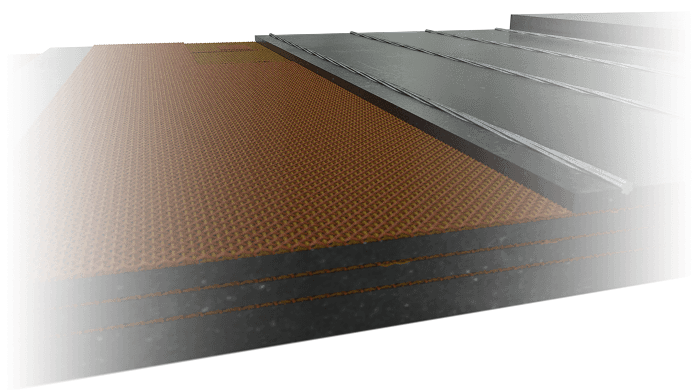
Fabric belts may also have printed or molded markings along the edge or underside, such as EP 400/3 or 330/3. These markings identify the carcass, strength rating, and ply count. Our breakdown of fabric belt types decodes these ratings and compares EP, NN, and other carcass constructions.

Need a replacement fabric belt? We can match it.
Fluent builds trough idler, slider bed, and flat idler custom conveyors that use fabric belts every day, so we specify belts around how they perform in service. We supply replacement fabric belts for our own equipment and for belt conveyors from other manufacturers, open-ended or endless.
Send us a photo of the printed rating and a cut edge, along with the width, length, and smallest pulley diameter, and we'll match the carcass, covers, and splice.