









Copyright © 2026 Fluent Conveyors, LLC. All rights reserved.
The Fluent Conveyors logo is a registered trademark of Fluent Conveyors, LLC. Serial Number 97664258 Registered on Dec. 12, 2023


Copyright © 2026 Fluent Conveyors, LLC. All rights reserved.
The Fluent Conveyors logo is a registered trademark of Fluent Conveyors, LLC. Serial Number 97664258 Registered on Dec. 12, 2023
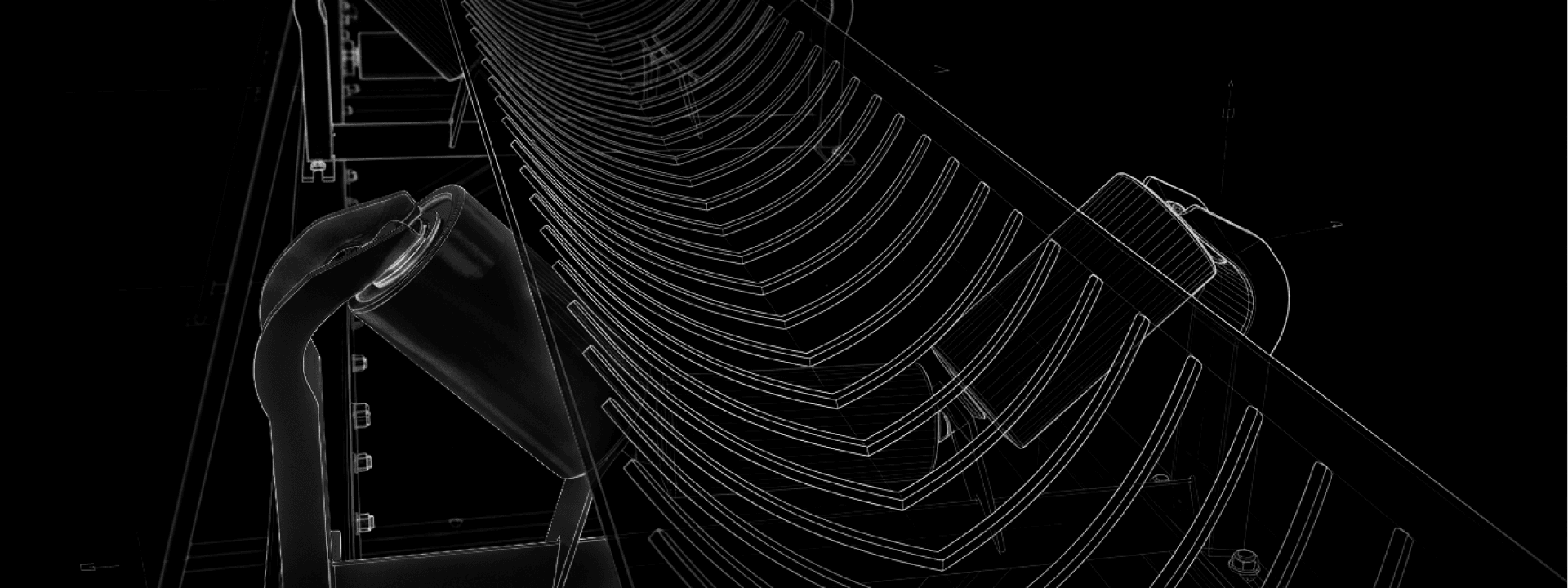
Belt Conveyors for Bulk Materials runs 815 pages in its current printing. Engineers call it the Belt Book. Fluent calculates capacity, belt speed, and horsepower from its methods on every pulley-driven bulk machine we build.

Belt Conveyors for Bulk Materials is an engineering handbook that CEMA publishes alongside its numbered conveyor standards. It supplies methods rather than requirements, which means a specification cannot cite a clause from it the way it cites ANSI/CEMA 402.
Coverage spans basic engineering data, design fundamentals, belt conveyor capacities, belt selection, general application guidance, and the Ki and Ai factors behind belt and idler resistance. The second printing carries imperial and metric units through the text, figures, and tables.
Appendix D is the one part of the book that reads like a requirement. It holds the minimum installation criteria for bulk belt conveyors, and CEMA sells it as a standalone publication for that reason. Our page on conveyor installation standards works through those criteria and how they divide between the manufacturer, the installer, and the facility.
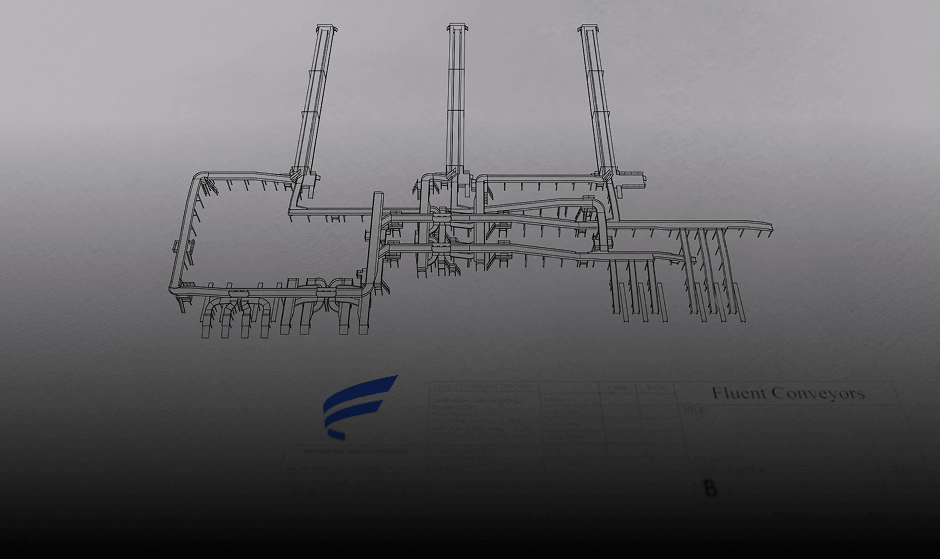
The title states the scope. The book addresses belt conveyors carrying bulk material, which describes most of what we manufacture and none of what a package line needs.
A sprocket-driven conveyor moves its load through chain pull along a rail rather than belt tension around a drive pulley, so the book's tension chapters have nothing to act on. Load cross-section math still applies to the material being carried. Chain manufacturer data governs the drive, the sprockets, and the rail.
Belt Book outputs arrive in sequence, and each one constrains the next.
We release our calculations with approval drawings.
Include these measurements and details when submitting your RFQ to aid our calculations.
Material classification supplies the first two inputs, and ANSI/CEMA 550 assigns the code behind them. A labeled estimate is more useful than a blank field. See our guide to writing a conveyor RFQ for more information.
CEMA published the first edition in 1966 at 331 pages. The 7th edition was issued in 2014, and the second printing followed in 2020 at 815 pages. A specification citing the 7th edition without naming the printing points at a document with known corrections in it.
The 8th edition is under development through CEMA's engineering conference, where member companies revise the chapters. CEMA has published no release date for the 8th edition.
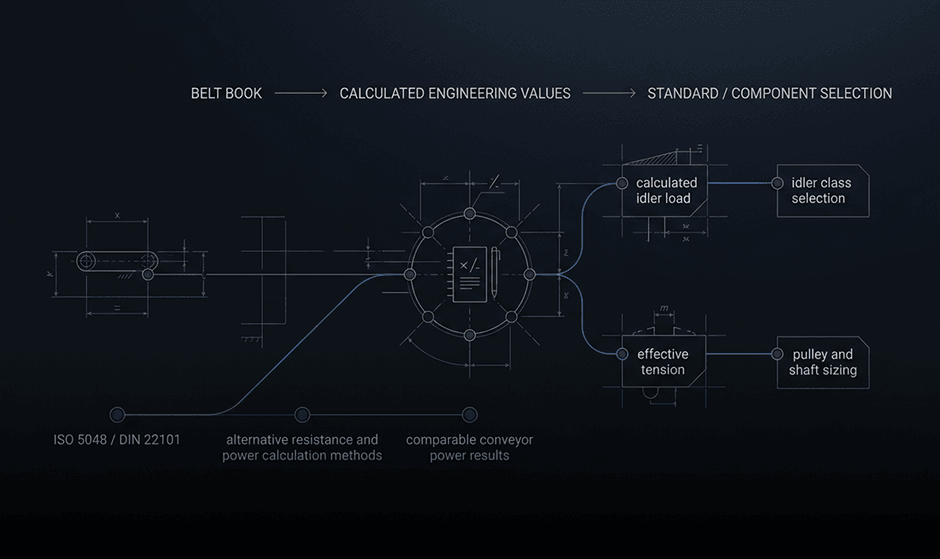
The Belt Book produces numbers, and the numbered CEMA standards turn those numbers into part selections. Calculated idler load picks the class in the CEMA idler class tables, and effective tension sizes the drum and shaft under ANSI/CEMA B105.1.
Outside North America, the same work runs on ISO 5048 or DIN 22101. Those documents model rolling and flexure resistance with a base friction factor and correction terms, so a metric calculation and a Belt Book calculation on the same conveyor produce comparable power figures without matching line for line.

Send your material and its bulk density, target tonnage, centers, lift, and incline, and our engineers will return capacity, belt speed, and horsepower figures with the quote.