









Copyright © 2026 Fluent Conveyors, LLC. All rights reserved.
The Fluent Conveyors logo is a registered trademark of Fluent Conveyors, LLC. Serial Number 97664258 Registered on Dec. 12, 2023


Copyright © 2026 Fluent Conveyors, LLC. All rights reserved.
The Fluent Conveyors logo is a registered trademark of Fluent Conveyors, LLC. Serial Number 97664258 Registered on Dec. 12, 2023

ANSI/CEMA 550 specifies material codes based on density, size, flowability, abrasiveness, and hazards. CEMA material codes are what a bulk belt conveyor gets sized against. They classify materials, not equipment.

CEMA 550 presents material classifications with the physical characteristics of each, the hazards affecting conveyability, and test procedures supporting equipment selection criteria. It leads CEMA's standards program because the material decides most downstream engineering and parts choices.
Five coding systems make up the classification.
Bulk density: weight per cubic foot as conveyed
Size: fines through lumps
Flowability: free, average, or sluggish
Abrasiveness: particle hardness, shape, density, and size combined
Hazards and miscellaneous properties: dust, aeration, stickiness, corrosiveness, temperature, explosiveness
The five combine into one string. For example, bituminous coal carries the code 50D335LNXY, and CEMA's belt cleaner standard identifies the 5 in that string as its abrasiveness rating. A code only reads against the document's own key, so codes should be looked up, not interpreted.
Chapter I fixes the vocabulary behind each value. That is the material-side companion to the conveyor terms and definitions our drawings and quotes are written in. The coded table gathers CEMA's handling characteristics data into one place, the same data set published in Belt Conveyors for Bulk Materials.
The most common error we see on a bid is treating 550 as an equipment criterion. It carries none.
Certification: No conformity mark exists for a material classification, so "CEMA 550 compliant conveyor" describes nothing measurable.
Idler class: CEMA 502 sets the dimensions and load ratings behind the idler class tables from B through F, and a material code is one input to that selection rather than the class itself.
Capacity, tension, and power: Belt conveyor calculation methods produce those figures for one defined application.
Discrete loads: Packages and unit loads fall under unit handling belt conveyor practice instead.
Where a specification asks for equal troughing idlers at a "CEMA 550 rating," it has merged two documents. Send the material code and the tonnage, and engineering resolves the class.
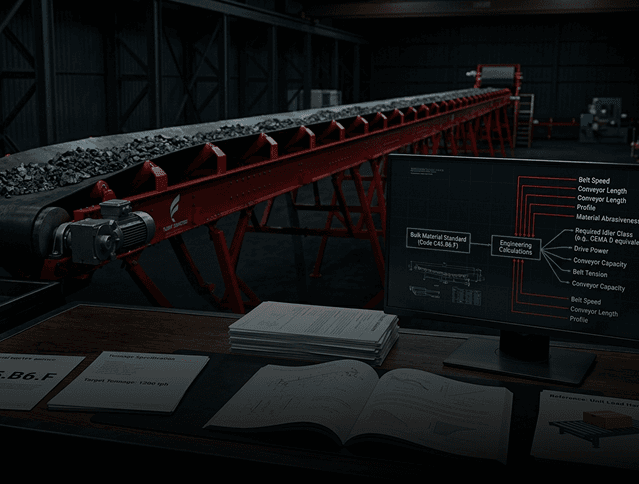
Each coded property lands somewhere physical.
Two properties play the biggest role in equipment specification: Density sets the load the structure and drive are sized against, and lump size sets a minimum belt width no matter how light the material is.
The material table covers commodities, running alphabetically from adipic acid to roasted zinc ore. Sand, gravel, crushed stone, coal, wood chips, glass cullet, and cement all carry codes, so aggregate handling can be specified straight from the table.
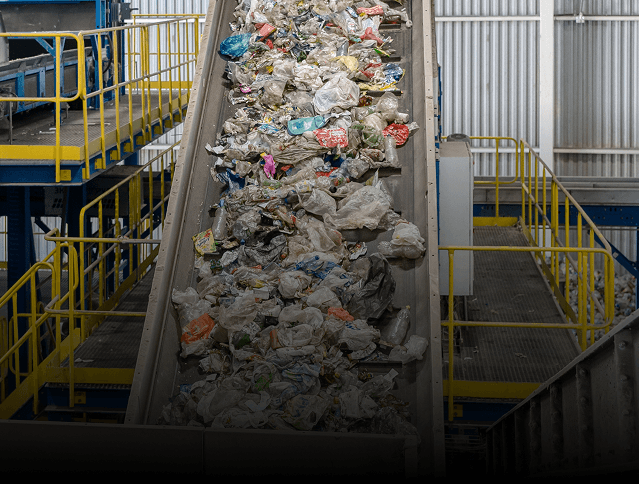
Some of our core industries handle material outside CEMA material codes. Shredder residue, mixed municipal solid waste, single-stream recycling, construction and demolition fines, and processed scrap metal are engineered feedstocks with no published classification.
We characterize those applications directly. Our engineers work from a measured density and size distribution of the actual stream, the facility's inbound mix, and build history on comparable plants, and a customer sample or screen report replaces the estimate where one exists.
Send this with the RFQ, and engineering can quote your conveyor or belt without a second round of questions.
Our RFQ writing guide covers how to reference a document without locking the specification to a superseded printing.
The current edition is ANSI/CEMA 550-2020, approved March 17, 2020 as a revision of ANSI/CEMA 550-2003 (R2015). That revision added metric conversions, updated the bulk density table in Chapter III, and added a table explaining how to read a material code. Older printings stay in circulation and turn up in legacy specifications. Our procurement checklist covers the edition wording. Buy the document from CEMA or an authorized reseller; it ships as a single-user licensed PDF, so this page maps the scope without reproducing the tables.
Three other CEMA documents use 550 output. Idler class follows from density and lump size, belt cleaner class from abrasiveness and moisture, and impact bed and cradle dimensions from lump size and drop height. Our standards and compliance hub maps how the rest relate.

Material classification gets priced into the quote. Send the density, lump size, throughput, incline, and operating environment, and our engineers will confirm the classification and specify the trough angle, idler class, and belt construction that follow from it. Every machine we build is a custom conveyor sized to the material in front of it.