








Copyright © 2026 Fluent Conveyors, LLC. All rights reserved.

The Fluent Conveyors logo is a registered trademark of Fluent Conveyors, LLC. Serial Number 97664258 Registered on Dec. 12, 2023


Copyright © 2026 Fluent Conveyors, LLC. All rights reserved.
The Fluent Conveyors logo is a registered trademark of Fluent Conveyors, LLC. Serial Number 97664258 Registered on Dec. 12, 2023
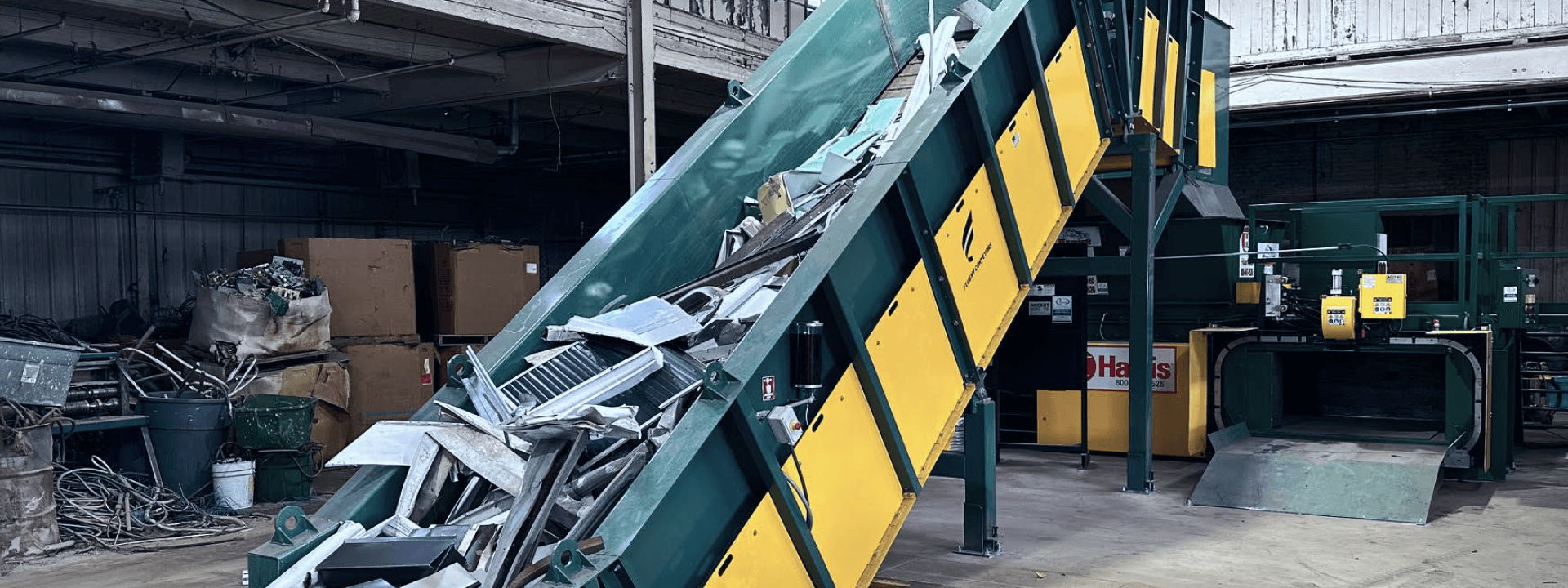
ISO 5048 outlines how to calculate the operating power required at a belt conveyor's drive pulley and the tensile forces carried by the belt. It applies to belt conveyors supported by carrying idlers. In the United States, it has no force of law unless a contract or specification requires it, most often on export projects. Our ISO compliance overview covers the other ISO documents that may apply to a conveyor.

ISO 5048 is a calculation standard. It defines the resistance to belt motion, the peripheral force required at the drive pulley, the operating power that follows from that force, and the tensile forces in the belt. It also addresses capacity and cross-section for a smooth, patternless belt.
ISO describes the method as simplified. Conveyors with multiple drive points or an uneven vertical profile require individual analysis rather than the standard procedure. Patterned belts also sit outside the capacity clause, so chevron cleated belts on steep inclines have capacities calculated through other methods.
The carrying-idler requirement also defines the drive arrangement the method assumes. A pulley-driven conveyor moves the belt through friction at the drive pulley, and the standard's tension model is built around that mechanism.
Applicability to Fluent conveyors depends on how the carrying strand is supported, not on the belt profile or the material being moved.
Rotational resistance in the carrying idlers is the largest single term in the standard's main resistance group. That means idler count, roll diameter, spacing, and bearing drag affect the power calculation, not just how the belt is supported.
The standard groups resistance into five categories. Each corresponds to a physical part of the conveyor or its operating conditions.
Those resistance values combine into a peripheral force, which is then used to calculate power and belt tension. Each result affects a different part of the machine.
Capacity is calculated separately from power. Trough angle, surcharge angle, edge distance, and belt speed together determine the material cross-section a given belt width can carry.
Calculated power establishes the motor rating and the reduction needed to reach the target belt speed. Motor and gearbox selection follows from the number, along with starting behavior and the torque delivered into the headshaft.
Force at the drive establishes shaft diameter, bearing loads, and the wrap and pulley lagging needed to transmit force without slip. Traction is a separate check from strength.
ISO 5048 allows secondary resistance to be approximated with a length-dependent coefficient applied to the main resistance, but it limits when that shortcut is reliable. The standard states that the coefficient approach produces reliable peripheral-force values on conveyors longer than about 80 m, or roughly 262 ft, between centres. On a long conveyor, secondary resistance is relatively small compared with the main resistance.
On shorter conveyors, material acceleration at the loading point, skirt friction, cleaner drag, and pulley losses can make up a much larger share of total resistance. A short conveyor is not just a smaller version of a long one, so applying the same shortcut can produce a power figure without a reliable margin.
Length on a Fluent conveyor is determined by the application, so the calculation is handled project by project. When centre distance falls below the threshold, secondary resistances are calculated individually instead of approximated.
We use the calculation method required by the project. For equipment built for service in the United States, that is normally CEMA. When the destination market or project specification requires ISO 5048, we calculate to ISO 5048 and can provide the output in metric units.
Both methods model the same underlying physics, but they use different coefficient sets and treat secondary losses differently. As a result, they can produce different horsepower values for the same conveyor. The reference work behind the domestic method is covered on our page for the CEMA Belt Book.
If a project specifies one method but the buyer already has figures from the other, we compare both results with the component load ratings for the machine and flag meaningful differences during quoting rather than after the order.
ISO 5048 is a calculation standard, not a manufacturing specification. It produces force, power, and tension values. Engineering then turns those values into a machine that can handle the required duty.
Calculation: resistance, peripheral force, operating power, belt tension
Mechanical design: drive, pulleys, belt, take-up, idlers, shafts, bearings
Structural validation: frame stress, impact zones, deflection under full load
Manufacturing and verification: drawings, materials, fabrication, testing, records
Stage 2 converts the calculated values into hardware, including the idler selection and spacing assumed in the power calculation.
Stage 3 adds structural analysis for conditions ISO 5048 does not address. On engineered projects, finite element analysis can be used to evaluate impact at the load point, frame deflection under a full belt, and stresses at connection details. Our conveyor quality assurance page covers the tests and records produced at stage 4.
Documentation carries those values into operation. The trough idler owner's manual shows the format supplied with a finished machine, including the operating values established during engineering.
Those values also define the machine's operating limits. Running a conveyor above its rated capacity or at a speed the drive was not designed for falls outside our warranty coverage.

Belt dimensions are covered by ISO 251, including belt widths, lengths, and the tolerances that help determine whether a replacement belt fits an existing frame.
Belt performance is covered by other documents. The ISO conveyor belt standards address properties such as conductivity, flammability, and carcass construction. Those values come from the belt manufacturer's testing rather than from the conveyor power calculation.
Machine safety also sits outside ISO 5048. ISO 12100 provides the risk assessment and risk reduction method used for guarding and stop decisions, but it does not address power or tension.
Our standards library shows how calculation, safety, and management-system standards divide across ISO, CEMA, ASME, and OSHA.


If a project requires a specific calculation method, include it in the RFQ so it can be accounted for during quoting. Send the conveyor type and carrying-strand support method, centre distance and elevation change, material and bulk density, required throughput, fixed belt speed if applicable, loading arrangement and skirt length, accessories that add resistance, and whether the calculation output must be delivered in metric units. Our RFQ writing guide covers the rest of the package.