









Copyright © 2026 Fluent Conveyors, LLC. All rights reserved.

The Fluent Conveyors logo is a registered trademark of Fluent Conveyors, LLC. Serial Number 97664258 Registered on Dec. 12, 2023


Copyright © 2026 Fluent Conveyors, LLC. All rights reserved.
The Fluent Conveyors logo is a registered trademark of Fluent Conveyors, LLC. Serial Number 97664258 Registered on Dec. 12, 2023

A single industrial conveyor can cost $25,000–$300,000+, depending on the type, complexity, size, and add-ons. A conveyor system often reaches seven figures. This guide explores the pricing factors and payoff calculations that help plant owners plan their next equipment purchase.

A conveyor can be an unpowered gravity roller section in a stockroom or a heavy-duty scrap infeed system, so conveyor pricing involves a large range. Industrial conveyors used for recycling, waste, and bulk materials fall between those extremes.
Below are general market figures that cover equipment unless noted.
Heavy-duty conveyor systems are usually priced per conveyor or per project because engineering, drives, and controls account for a large share of the total.
Conveyor quotes generally fall into four tiers:
Equipment only
Configured equipment with controls and guarding
Installed equipment
Turnkey systems
Two quotes are only comparable if they are equivalently scoped.
Installed pricing includes costs that do not appear on an equipment-only quote. For example, Maryland assessment notes that its estimate includes electrical work and potentially stairs and platforms, with price changing according to conveyor width, length, type, and installation requirements.
Scope can more than double the project budget. Portland Water District received an 835,930 USD turnkey proposal for a new conveyor system that included demolition, structural modifications, drives, electrical work, and automation. The board set a 900,000 USD contract limit within a 2 million USD budget for the broader upgrade. Defining total project scope prevents cost overruns.
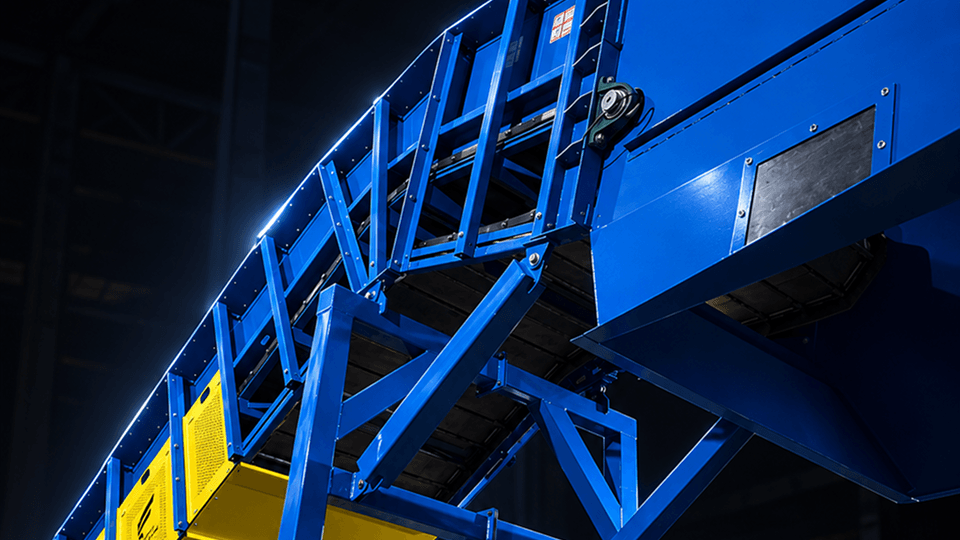
These are typical equipment budget ranges for the heavy-duty conveyor types we build for recycling, waste, scrap, and bulk handling. Size, belt or chain construction, and optional features can push an individual project outside these ranges.
Pulley-driven belt conveyors sit at the lower end of the heavy-duty price range. A slider bed supports the belt on a steel pan, making it suitable for loose or packaged material at moderate loads. Flat idler and trough idler conveyors support the belt on rollers, while the trough shape carries more bulk material per foot. Our slider bed vs. roller bed comparison explains the trade-offs.
Length and belt construction account for much of the cost on these systems. More length means more frame, belt, and idlers, while belts with additional plies or thicker covers cost more per foot.
Roller chain conveyors cost more because their construction uses more steel. They run ANSI chain on ASCE rail, driven by sprockets through a chain drive from the gearbox to the head shaft. That construction withstands impact, sharp edges, and heavy loads that could damage a rubber belt.
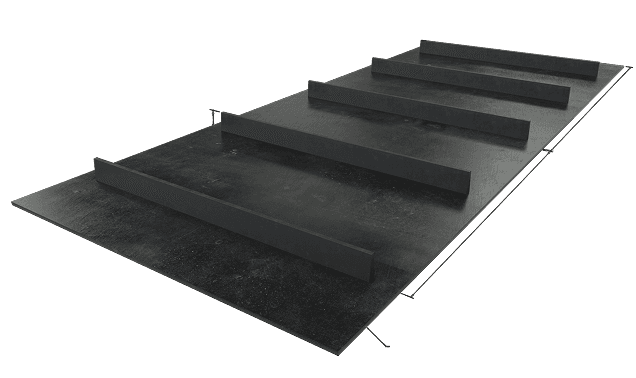
The belt attached to the chain is a major price factor. A rubber combination belt is the lowest-cost option and suits fiber and lighter mixed loads. Hinged steel, apron pan, and Z-pan belts cost more but withstand scrap, C&D debris, and other severe materials.
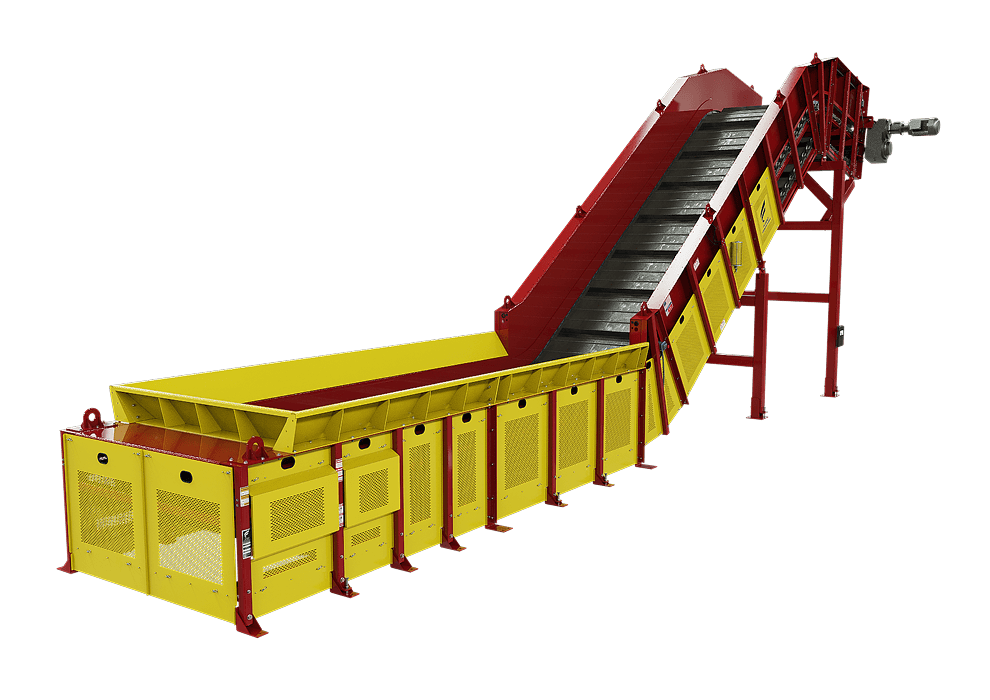
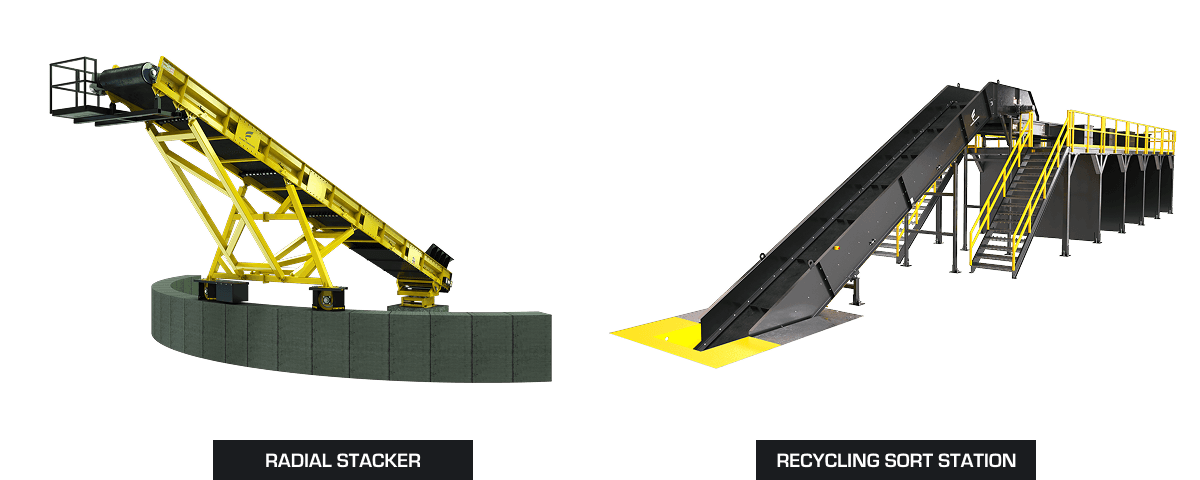
Oneida County, Wisconsin, listed a 175,000 USD stacking conveyor in its proposed 2024 equipment requests. That figure was a budget request, and it falls within the typical range for a roller chain radial stacker or belt stacker.
Sort stations are priced as systems rather than single conveyors. A station may combine an elevated platform, sort conveyor, chutes, infeed conveyors, and controls. Custom stations designed around a specific building generally cost more than standard sort stations.

Six variables explain most of the difference between two conveyor quotes.

Length adds frame, belt or chain, and supports. Width increases the cost of every component that spans the conveyor. Inclines, pits, hoppers, and nose-overs require additional steel and engineering, so identify the conveyor configurations your layout requires before comparing prices.
Heavier, sharper, or more abrasive material requires a stronger frame, heavier belt, and larger drive. Throughput determines belt width and speed. Sizing around your real peak load avoids paying for capacity you will not use or installing a conveyor that cannot keep up with bulk materials at full volume.
Belt pricing depends on carcass construction and cover compound. Fabric belts cost less than steel cord. Covers rated for heat, oil, or flame are more expensive. On roller chain conveyors, plate thickness and chain pitch drive cost. Our guide to conveyor belt types compares the options.
A simple start-stop panel costs far less than a PLC-integrated system with sensors, interlocks, and remote monitoring. Ask whether the quote includes control panels and programming or leaves those items to your controls integrator.
Pull cords, e-stops, and guarding also add cost, and OSHA guarding rules make many safety components mandatory.
Wet, corrosive, hot, or dusty sites may require coatings, sealed bearings, and upgraded materials. These options increase the upfront price but can reduce lifecycle cost, especially where rust would otherwise shorten frame life.
Installation cost depends as much on the site as on the conveyor itself. A conveyor placed on a flat slab with nearby power is far cheaper to install than one requiring a pit, new foundations, structural changes, or a mezzanine.
Warehouse installers often quote 40–120 USD per foot for mechanical work. Heavy-duty installations are usually priced per project after a site assessment.
Contingency covers costs that cannot be fully defined at the start. Portland Water District's 900,000 USD contract limit was 64,070 USD, or about 7.7%, above the quoted 835,930 USD. The utility also expected six to eight months before the new system was operational, so budget for procurement and installation time as well as the cost of operating without the line.
A typical project may involve several contractors:
The conveyor manufacturer
Installer
Electrician
Controls integrator
Clear scope boundaries prevent work from being missed when coordinating multiple vendors.
Cost per foot is simply the equipment price divided by conveyor length. It works reasonably well for light-duty systems built from repeating sections.
On heavy-duty conveyors, however, much of the price comes from conveyor components that do not scale directly with length, including the drive, head and tail sections, transfer points, controls, and engineering.
This illustrative example uses a 60,000 USD fixed package plus 1,500 USD per foot for frame and belt:
The longer conveyor costs twice as much overall but half as much per foot. Per-foot pricing is most useful when comparing conveyors of similar length and becomes unreliable when scaling a quote up or down.

The application determines how heavily a conveyor must be built, making it one of the strongest predictors of price. Fiber and single-stream recycling sit at the lighter end. MSW, C&D debris, and scrap usually require heavier recycling conveyors, often with steel belts.
Baler infeed units range from slider bed conveyors for clean fiber to heavy-duty roller chain systems for mixed scrap. Pit-fed designs add civil work, and the conveyor must match the baler's feed opening and cycle.
An additional conveyor in an existing MRF was estimated at 100,000–200,000 USD installed in the Maryland needs assessment.
A complete facility operates at a different scale. An EPA webinar case described an 8.45 million USD MRF rated at 10 tons per hour. That figure covers the full facility, not the price of a conveyor.
Throughput helps put these figures in context. Maryland's statewide model estimated 9.2–10.3 million USD in upgrades across existing MRFs for approximately 190,150 additional tons of annual capacity. For MRF conveyors, cost per ton of added capacity can be more useful than the equipment price alone.
Scrap conveyors handle impact, sharp edges, and heavy loads, so they commonly use hinged steel or apron pan belts running on heavier chain.
Shredder infeed conveyors go further, adding crawler track belts and reinforced impact zones. That construction places them at the top of the single-conveyor price range. See our scrap metal conveyors for typical configurations.
Energy is one of the easiest operating costs to estimate. Multiply motor kilowatts (HP × 0.746) by annual operating hours and a load factor, as in this DOE method, then multiply by your electricity rate.
A 15 HP drive running 4,000 hours at 75% load uses about 33,570 kWh per year, equal to roughly 2,700 USD at the 2024 U.S. industrial average of 8.13 cents per kWh. Energy is only one part of total cost of ownership.
Belts and other wear parts can add up faster. The City of Ames, Iowa, budgeted 28,000 USD to replace one belt on its resource recovery system. Stephenville, Texas, received a 49,963.60 USD quote to refurbish a 20-year-old trough belt conveyor with new idlers, pulleys, and a scraper. Build replacement intervals into the budget from the start.
Downtime can dwarf those costs. In its 2025 board report, Portland Water District estimated that its aging system required about 100,000 USD in parts and specialist labor every 12–18 months. When the conveyor could not operate, the utility hauled liquid sludge at about 117,000 USD per month and projected more than 1.4 million USD in hauling costs for 2025. Downtime reduction should be factored into any operating cost comparison.
Payback compares the installed cost of the conveyor with the savings or additional value it produces each year. Use your own numbers wherever possible:
• Annual net benefit: labor saved + downtime avoided + maintenance avoided + added margin − added energy and service
• Labor saved: hours saved per year × loaded hourly rate
• Payback in months: installed cost ÷ annual net benefit × 12
• ROI over 5 years: (annual net benefit × 5 − installed cost) ÷ installed cost
Here's an illustrative example for a 180,000 USD installed conveyor feeding a baler. It saves 6 labor hours per shift across 2 shifts and 250 days. Labor uses the BLS mean wage of 20.32 USD per hour for hand material movers with a 1.3 burden multiplier.
Base labor savings on hours rather than assuming the conveyor eliminates complete positions. The 10-ton-per-hour MRF in an EPA case study still employed 5 full-time and 15–20 temporary workers. In many cases, the more realistic benefit is fewer material-handling hours and greater throughput from the same crew.
Maintenance strategy also has a significant impact on ROI.
Enter your equipment budget, project costs, and expected savings to estimate installed cost, payback, and ROI.
Made-to-order equipment is commonly paid for in stages:
A deposit when the order is placed
Another payment before shipping
A final payment after delivery or startup
Staged payments spread cash requirements across the build and tie the final portion to delivery or operation.
Equipment loans and leases convert the purchase into a monthly payment. If monthly savings exceed the financing payment, the conveyor can generate positive cash flow while it is being paid off.
Borrowing still adds cost. Portland Water District estimated debt service of about 140,000 USD per year if it financed its upgrade. Our guide on conveyor funding covers additional options.
Municipal and solid waste buyers often fund conveyor projects through capital plans, bonds, or recycling grants. Private buyers may be able to expense equipment more quickly under federal tax rules such as Section 179. Check with your tax advisor before finalizing the budget or deciding whether to rent or buy.

Quotes are easiest to compare when every supplier receives the same information. Send these 10 details:
Material type and maximum lump size
Peak load and impact conditions
Throughput in tons or units per hour
Conveyor width and length
Incline and layout, including infeed, discharge, and transfers
Operating environment
Available power and voltage
Controls integration needs
Site constraints such as pits, ceiling height, and floor condition
Delivery location
Before comparing quotes, ask each supplier the same questions:
Controls: Is the panel included, and who programs it?
Freight: Is shipping included, and who unloads?
Drawings: When do you receive approval drawings?
Spare parts: Is a recommended spares list included?
Startup: Who commissions the conveyor and trains your crew?
A written conveyor RFQ puts every supplier on the same scope.
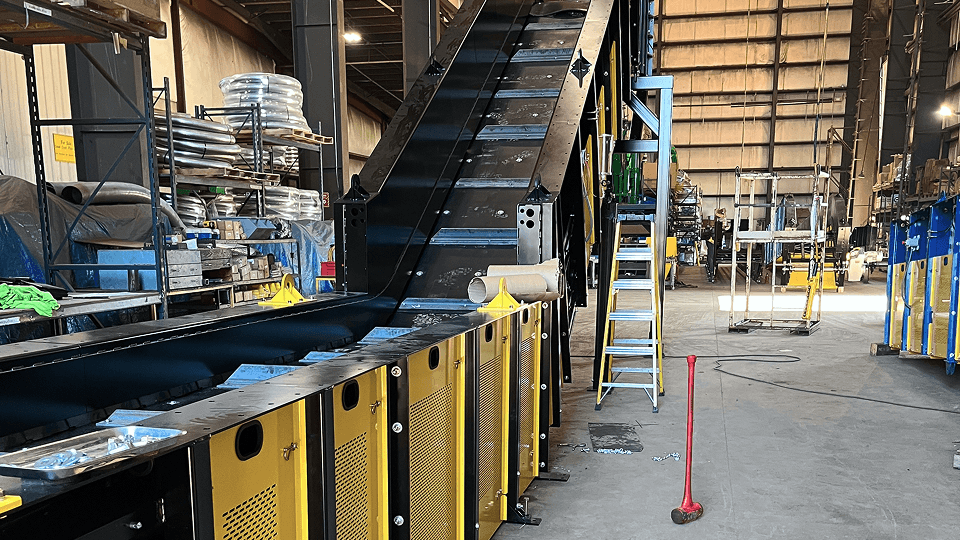

Fluent Conveyors designs and builds heavy-duty conveyors in the USA for recycling, waste, scrap, and bulk handling. Send us your material, throughput, and layout, and our engineers will return an itemized quote showing exactly what's included.
As a US conveyor manufacturer, we engineer each system around the load and operating conditions it needs to handle.