









Copyright © 2026 Fluent Conveyors, LLC. All rights reserved.

The Fluent Conveyors logo is a registered trademark of Fluent Conveyors, LLC. Serial Number 97664258 Registered on Dec. 12, 2023


Copyright © 2026 Fluent Conveyors, LLC. All rights reserved.
The Fluent Conveyors logo is a registered trademark of Fluent Conveyors, LLC. Serial Number 97664258 Registered on Dec. 12, 2023

A belt can arrive with the correct width, length, and rating and perform poorly if it was stored or handled incorrectly. Damage can occur in the warehouse or during staging rather than at the belt plant. ISO 5285 outlines best practices for preventing pre-installation belt damage. It is also one of the ISO documents where much of the responsibility sits with the buyer after delivery.

ISO 5285 provides guidance for packing, protecting, storing, lifting, and moving conveyor belts before they enter service. ISO/TC 41/SC 3 publishes the standard. It is guidance rather than a mandatory requirement, carries no legal force in the United States on its own, and only becomes a contractual obligation when a specification or purchase order names it.
Dimensional requirements belong to ISO 251. Belt performance requirements belong to the ISO belt property standards. ISO 5285 assumes those questions are already settled and focuses on what happens between the belt plant and the conveyor.
The standard also excludes light conveyor belts, which ISO 21183-1 defines as thin fabric-ply belting with thermoplastic coatings, typically used for indoor unit-load handling and often built into equipment as a component.
Applicability depends on belt construction, not conveyor.
That final exclusion matches the treatment under ISO 251. Hinged steel and pan-style belting has no textile carcass to compress, telescope, or absorb moisture, so the failure modes ISO 5285 is meant to prevent do not apply. These assemblies still need dry, supported storage to prevent corrosion and distortion.
If a specification cites ISO 5285 across a mixed order, apply it to the fabric-carcass belting and identify which items fall outside its scope.
Four problems account for many belts that arrive in good condition but install poorly. Risk increases with storage time and roll size.
These problems may not be visible while the belt is wrapped. They usually show up during tracking on the first run. Belt camber can be mistaken for a frame alignment problem before storage is considered. Our guide to storing conveyor belts covers how to prevent all four issues.
Belt specification and supplier handling requirements
Receiving inspection of incoming belting
Shop storage and staging
Belt installation and operational run test
Packing, protection, and shipment
Fluent supplies belts produced by other manufacturers, so stage 1 begins with the belt manufacturer's data sheet and handling instructions. Those instructions stay with the belt. Suppliers are qualified under our vendor quality process before their products are used on an order.
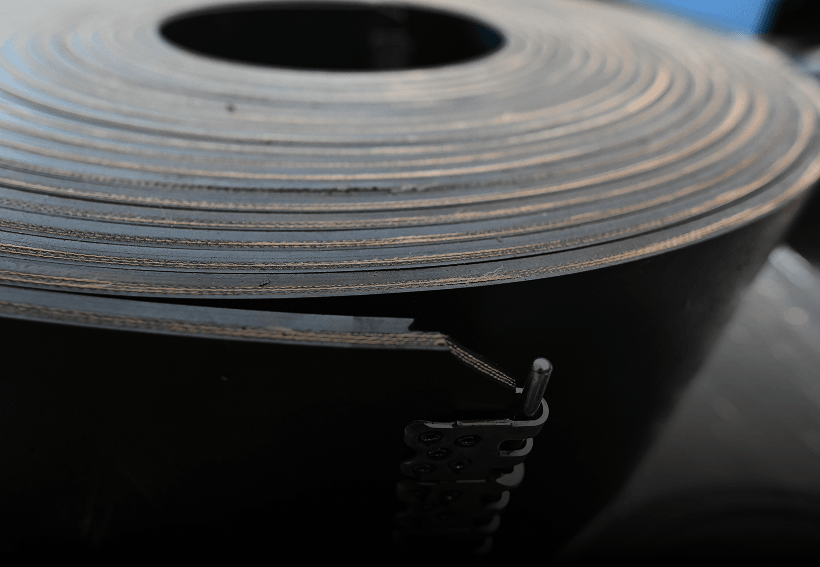
Belting is received on a core with the carrying side out, kept off the ground on supported stands, stored indoors, and protected from light and moisture. Rolls are not stored on edge or leaned against a wall. A roll kept in storage long enough to require rotation is turned in the direction marked by the belt manufacturer.
Stage 4 is where belts shipped on our custom conveyors receive different treatment than our replacement belt. On machines small enough to ship assembled, the belt is installed and run during operational testing, so it reaches the site already mounted on the frame. On larger machines, the conveyor may be disassembled for shipment, and the belt rolled again, bringing it back within the storage and handling conditions ISO 5285 addresses. Our conveyor quality assurance page covers what gets recorded.
ISO 5285 does not assign responsibility to a specific party, which is why storage disputes can become difficult after the fact. Belt condition passes through several hands, and the receiving record often becomes the most useful evidence later.
Note visible damage on the delivery paperwork before the driver leaves. Carrier claims become harder to support afterward.
Storage conditions can also affect warranty coverage. Belt manufacturers exclude damage caused by storage that conflicts with their published instructions. A belt that develops camber after a year on a concrete floor, for example, falls outside the manufacturer's warranty. Equipment supplied by Fluent is covered by our warranty terms, which likewise do not cover conditions created after delivery.
A project may include four sources of belt storage guidance with varying degrees of authority.
These sources generally work together. The CEMA Belt Book is the reference our engineers use on US projects, and it covers belt handling alongside capacity and horsepower methods. If the belt manufacturer's instructions are more restrictive than either ISO or CEMA guidance, the manufacturer's instructions should govern that belt.
ISO 5285:2012 remains the current published edition. A fourth edition is in development as ISO/DIS 5285. ISO registered the draft at stage 40.00 on 4 August 2026, and it is now in the enquiry phase with ISO members. ISO states that it is intended to replace the 2012 edition.
Until the new edition is published, specifications should cite ISO 5285:2012, or use wording such as "current edition at time of order." Our RFQ writing guide covers wording that can survive an edition change.

ISO 5285 covers storage and handling. It does not discuss the dimensional, performance, or calculation questions that appear in a belt RFQ. A full specification may also need a dimensional standard, a belt-property standard, and a calculation standard. ISO 5048 is the calculation document our engineers most often compare with CEMA methods during sizing because the two methods can produce different horsepower values for the same duty. Our conveyor standards overview maps the broader set, including management-system standards that apply to the company rather than the equipment.

Handling, protection, and packing requirements should be included in the quote. Send the belt construction and dimensions, the conveyor it will be installed on, expected storage conditions and staging duration, and any handling requirements in your specification.