









Copyright © 2026 Fluent Conveyors, LLC. All rights reserved.

The Fluent Conveyors logo is a registered trademark of Fluent Conveyors, LLC. Serial Number 97664258 Registered on Dec. 12, 2023


Copyright © 2026 Fluent Conveyors, LLC. All rights reserved.
The Fluent Conveyors logo is a registered trademark of Fluent Conveyors, LLC. Serial Number 97664258 Registered on Dec. 12, 2023
PVC conveyor belt types are defined by the underside, top surface, add-ons (such as cleats or V-guides, compound grade), and carcass. Every PVC belt combines these five traits, so selecting the right one means matching the complete specification to the conveyor and material. Below, we’ll cover everything you need to understand to specify the right PVC belt for the job.

A PVC conveyor belt uses a polyester or nylon fabric carcass coated or impregnated with polyvinyl chloride. Our guide to PVC belt basics covers the material itself. Here, the focus is on the features that distinguish one PVC belt from another.
Supplier catalogs use many product names, but those names generally describe the same five characteristics. For example, a single belt can be 2-ply, bare on the bottom, rough on top, and anti-static. Reading a PVC belt specification means accounting for all five traits together.
The carcass is the fabric structure inside the PVC. It carries belt tension, while the PVC protects the fabric and gives the belt grip, release characteristics, and chemical resistance. Our guide to fabric conveyor belt types covers carcass fabrics and construction in more detail.
Light-duty PVC belts commonly use 1–4 plies. Ply count indicates the number of fabric layers, while the tension rating indicates the allowable working pull in pounds per inch of width (PIW). Two belts with the same ply count can have different tension ratings, so match the rating first.
Additional plies generally make a belt stiffer and increase its minimum pulley diameter. Interwoven carcasses bind the layers into a single fabric structure so they cannot separate. Cross-rigid carcasses use stiff transverse yarns to keep wide belts flat, but that stiffness prevents the belt from troughing.
Solid woven PVC and PVG belts
Solid woven belts are at the heavy-duty end of the PVC range. Their carcass consists of one thick woven fabric saturated with PVC, making them suitable for long, high-tension lines in applications such as underground mining. PVG belts add rubber covers over the PVC for additional grip and wear life.
In U.S. underground coal mines, belts require MSHA approval under 30 CFR Part 14. Approval applies to a specific cover compound, carcass construction, and fabric type, so a substitute belt requires its own approval. We supply self-extinguishing PVC and PVG belting and provide the associated test documentation, including MSHA approval numbers.
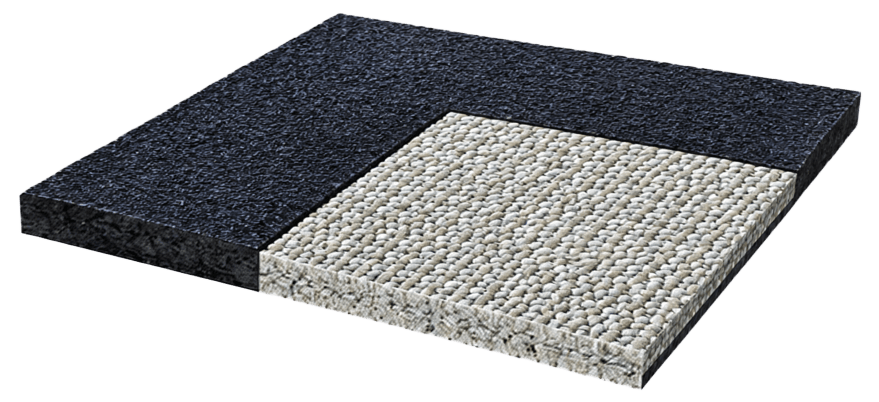

The top surface interacts with the product; the underside interacts with the conveyor. The bottom face affects how the belt runs against a slider bed or roller bed and how it engages the drive pulley. Suppliers often describe underside construction with three-letter codes or "top x bottom" shorthand. Naming varies by manufacturer, so check the data sheet description.

A COS belt has a PVC cover on top and bare or lightly impregnated fabric underneath. It may also be described as cover x bare. Fabric produces less friction and heat against steel than a PVC bottom cover, making COS a common choice for a flat slider bed conveyor.
A CBS belt, also described as cover x cover, has PVC on both faces. The bottom cover grips rollers and the drive pulley and withstands repeated roller contact, making CBS well suited to roller bed sections of package handling conveyors and inclines that require additional traction.
On a slider bed, however, the covered underside creates more drag, which increases heat and motor power requirements.
An FBS belt has fabric impregnated with PVC on both faces and no thick cover, sometimes written as friction x friction. “Friction” names the thin compound pressed into the fabric weave. FBS runs on a slider bed, though its skim-coated bottom grips more than the brushed bottom on a COS belt.
That makes FBS a general-purpose belt for light trash and waste conveyors and transfer runs, where some grip on both faces helps.
The top surface determines how readily the product grips or slides across the belt. Higher-grip surfaces generally become harder to clean and add thickness to the belt.
PVC conveyor belts come in different surface finishes to suit various material handling needs, including:
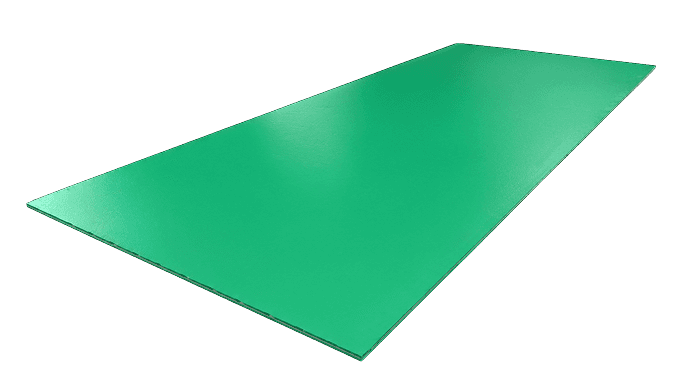
Smooth tops allow products to slide, accumulate, and transfer easily, and they are the easiest PVC surfaces to wash down. Smooth top conveyor belts are widely used for sortation and package handling.
On an incline, smooth PVC reaches its traction limit relatively quickly. The Engineering ToolBox lists 16 degrees as the maximum inclination for paper-wrapped packages on a smooth belt.
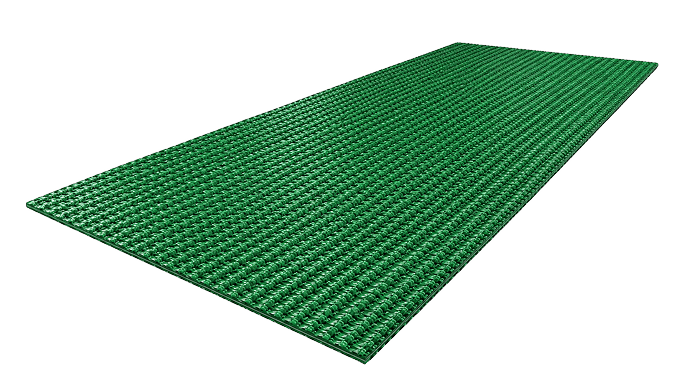
Rough top belts use a deep, irregular texture to grip cartons, bags, and totes on incline conveyors and declines.
The textured surface is harder to clean because it traps dirt. It also gives loose bulk material relatively little structure to push against, making cleats a better option when positive material retention is required.

Embossed surfaces such as crescent and diamond patterns fall between smooth and rough top. They provide additional grip for light inclines and damp products while remaining easier to clean than rough top.
Low-profile chevrons integrally molded into the PVC cover help retain loose material. Taller vulcanized chevrons are a separate construction covered on our chevron cleated belts page.
Patterns also increase belt thickness. A textured version of a belt may require a larger conveyor pulley than the smooth version of the same construction, so always check minimum pulley diameter when changing surfaces.
Textured surfaces rely on friction. Cleats and sidewalls physically restrain material, which becomes increasingly important when loose bulk is carried at angles where friction alone is not enough. Our guide to the best belts for steep inclines covers incline selection in more detail.
V-guides are PVC strips welded to the underside of the belt. Suppliers size them with a K number indicating width in millimeters; for example, a K13 guide is 13 mm, or about 1/2 inch, wide.
They require grooved pulleys and a slotted bed, so they can only be used on conveyors designed for them. A V-guide provides steering force, but the frame and pulleys still need to be square before you track the conveyor belt.
Fabricated belts have two important specification rules:
The largest minimum pulley diameter governs. The base belt, cleats, and sidewalls can each have their own minimum pulley diameter. The conveyor pulley must meet the largest requirement. Cold service can increase those minimums.
Add-ons can affect certified properties. Welding profiles onto a belt can change its anti-static, conductive, or flame-retardant characteristics.
Ask for documentation covering the finished belt with its cleats and sidewalls installed. Our page on ISO conveyor belt standards explains the property tests behind these ratings.
Compound grade describes the conditions the PVC formulation is designed to withstand. Color may identify a product family, but a white, blue, or green belt has a food, static, or flame rating only if its data sheet and declarations specify one.
Our industrial belts overview covers specialty compounds across different belt materials.
FDA and EU food-contact requirements are separate. A PVC belt can conform to FDA requirements while lacking EU approval, so request the declaration of conformity required for your market. Our page on food-grade conveyor belts covers the topic in more detail.
Packaging and food lines equipped with metal detectors require a belt without conductive additives and a splice without steel. A heat-welded endless splice or plastic hinge splices can prevent the splice from triggering the detector.
Anti-static PVC limits charge buildup on the running belt, but it may not dissipate a charge already carried by the product. Electronics and other ESD-sensitive lines require a conductive belt. Our guide to anti-static conveyor belts explains the distinction.
Standard PVC has limited resistance to oils, greases, and solvents, which can swell and soften the cover. Oily parts, fryer lines, and grease exposure require an oil-resistant belt compound.
Flame-retardant light PVC belts are commonly certified to ISO 340 or the older MSHA 2G method. Small-scale tests have limitations. For example, in a U.S. Bureau of Mines test, eight PVC belts that passed the 2G acceptance test were subjected to a larger laboratory test, and four failed.
Specify flame performance according to the test required by your site. See our guide to fire-resistant belts for additional options.
Standard PVC compounds are typically rated for continuous service at about 14–158 °F (-10 to 70 °C), as shown on this Ammeraal Beltech data sheet. Below that range, the cover can stiffen and crack; above it, PVC begins to soften. Hot products require a heat-resistant belt.
We build slider bed conveyors and specify PVC belting for them every day. The table below provides a starting point by conveyor type. Always confirm the belt rating and minimum pulley diameter against the specific line.
PVC performs with light-to-medium unit loads and light bulk material, but some operating conditions call for a different belt material:

Tell us what you're running, and we'll help identify the right replacement.
Fluent builds slider bed and idler-supported conveyors, so we understand how PVC belting interacts with the bed, pulleys, and overall conveyor geometry. We supply replacement conveyor belts in PVC from 120–750 PIW, with smooth, rough top, crescent, chevron, and cleated surfaces, FDA covers, and open-ended or endless splices.
Send us the belt stamp, width, length, and conveyor type, and our engineers will spec the replacement.