




Copyright © 2026 Fluent Conveyors, LLC. All rights reserved.
The Fluent Conveyors logo is a registered trademark of Fluent Conveyors, LLC. Serial Number 97664258 Registered on Dec. 12, 2023


Copyright © 2026 Fluent Conveyors, LLC. All rights reserved.
The Fluent Conveyors logo is a registered trademark of Fluent Conveyors, LLC. Serial Number 97664258 Registered on Dec. 12, 2023
ISO 9001 sets requirements for quality management systems. Accredited registrars certify organizations against the standard, not the equipment they build. A certificate identifies the sites and activities covered by the audit, so it shows how a company manages quality but does not prove that a specific conveyor meets an engineering requirement. Our ISO compliance overview covers the other ISO documents that may apply to a conveyor.

ISO 9001 defines what a quality management system must do:
Control processes
Establish competence
Maintain documented information
Manage design and development
Control external providers
Monitor and measure performance
Authorize product release
Handle nonconforming output
Address the causes of failures
ISO publishes the standard. Accredited registrars audit organizations and issue certificates against it, which is why ISO and certification are often blurred together in supplier marketing. More than a million organizations hold ISO 9001 certificates worldwide, and each certificate includes a scope statement identifying the activities and locations covered by the audit.
The scope statement matters more than the logo on the certificate because it shows what the registrar actually reviewed. No ISO 9001 certificate establishes a conveyor's load rating, belt speed, guarding, or other machine-level requirement. Those values come from separate engineering and safety standards.
ISO 9001 asks whether a company controls its processes consistently. Engineering standards define what the finished conveyor has to do.
Fluent Conveyors builds and supplies equipment to specification but does not hold an ISO 9001 certificate from an accredited registrar.
Fluent provides process evidence, including controlled engineering drawings and revisions, signed inspection records, material and process certifications, published quality requirements for outsourced parts, and test records for each machine. Buyers evaluating a conveyor supplier can review that evidence directly.
This matters because an ISO 9001-registered buyer is responsible for defining how it selects, evaluates, and monitors external providers. That is why capital-equipment purchases often include supplier questionnaires. Fluent completes those questionnaires, particularly for customers outside the United States whose own management systems require them. Some purchasing systems accept documented process controls; others require an ISO 9001 certificate. The buyer sets that threshold. See our guide to evaluating conveyor manufacturers for more information.
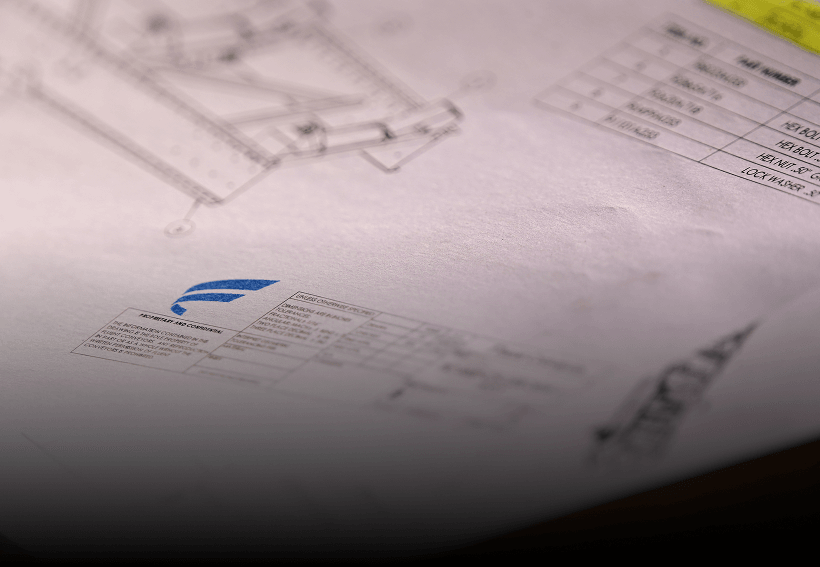
Every manufactured part on a Fluent conveyor has a released engineering drawing. The order of authority behind that part is fixed.
Purchase order release
Latest released engineering drawing
Engineering specifications
Approved written engineering deviations or waivers
Vendor quality requirements
If two documents conflict, engineering resolves the issue before moving on.
A drawing reaches released status after two engineering passes. The machine is modeled in 3D CAD using the material and bulk density, throughput, incline, cleanout method, and operating environment supplied with the enquiry. A second engineer then reviews the model before release. On a custom conveyor, this is where dimensional and application requirements are resolved.
Our RFQ writing guide lists the inputs we need to define your conveyor requirements correctly.
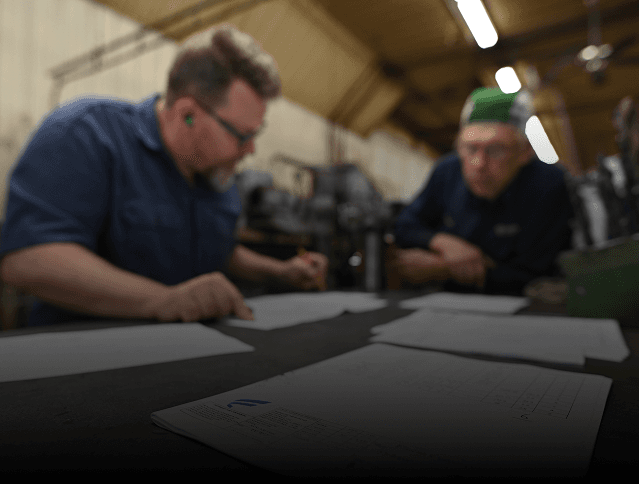
Fluent manufactures conveyors and outsources selected fabricated components to qualified vendors. Weldments, machined parts, laser-cut and formed components, assemblies, purchased-to-print components, prototype runs, and production parts are all covered by our purchase order vendor quality requirements, which become part of the order when a vendor accepts it.
Those requirements define the process controls vendors must maintain, including operator qualification and training, CNC programming, machine capability and accuracy, fixture condition, tool wear, welding fixtures, inspection equipment, calibration systems, material traceability, and process repeatability. These controls support consistent production, but they do not excuse a part that misses the drawing.
We define inspection frequency, and the vendor amends it as needed.
Weldments are checked individually rather than by sampling. Structural weldments can distort in ways machined parts do not, and even a small error in frame squareness can affect whether a replacement pulley fits the bearing centers shown on the drawing.
Documentation accompanies the parts, including a signed QA inspection sheet plus material, heat-treatment, coating, and welding certifications where applicable. Shipment is not authorized until the required paperwork is complete, returned, and reviewed. Missing documentation can hold the shipment.
Fluent can inspect, audit, or verify incoming product and reject it regardless of the vendor's own records. Final responsibility for the part therefore remains with the company supplying the finished conveyor. Vendors that meet these requirements remain on our approved vendor list.
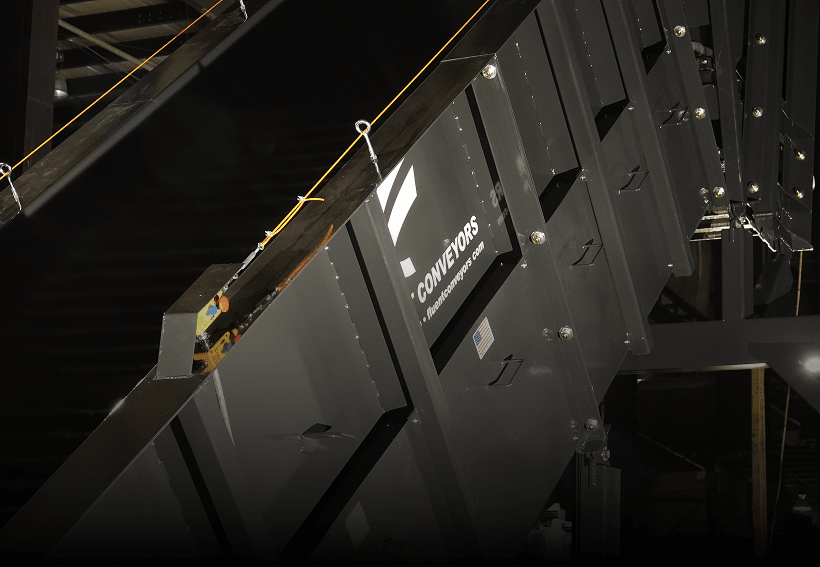
A part is nonconforming when it fails to meet the drawing, specification, approved deviation, or purchase order requirement. The response follows a defined process.
For the buyer, the purpose is straightforward: keep a part that missed its drawing from reaching the finished conveyor. The supplier code of conduct sets the broader expectations those vendors work under.

Fluent's fabrication follows the legal requirements for operating a structural steel shop in the United States.
Frames are built from 3/16-inch rectangular tubing with 1/4-inch steel pan sidewalls and 1/4-inch supports in ASTM A36 steel, with Grade 8 hardware at fastened joints. CNC machining and automated braking help hold cut and bend tolerances across a production run. Full material and construction details are covered on our US conveyor manufacturer page.
Sprockets are cut in-house, so tooth form and runout are controlled to Fluent's production requirements. On roller chain conveyors, those dimensions affect chain engagement and belt tracking.
Three practices carry much of the quality-control burden in structural fabrication.

AWS D1.1 is the main structural welding code for steel in the United States. It covers qualification of welding procedures and welders as well as inspection and acceptance criteria. Following the code and using qualified welders is a process requirement, not a company certification.
Tape measures, calipers, micrometers, gauges, and squares used to accept parts must remain within calibration and traceable to recognized measurement standards. An out-of-calibration tool can make bad parts appear acceptable on paper.
Mill test reports verify the material grade. Steel specified as ASTM A36 must be documented as ASTM A36, and coating and heat-treatment records follow the same principle.
Assembly ends with an energized run. Every conveyor is assembled and run for more than 10 hours while speed, tracking, alignment, noise, safety stops, and electrical function are checked and recorded. Our conveyor quality assurance page describes that process in full. The records are retained with the build record and can be released on request.
Fluent does not manufacture every replacement part it sells. The source of a part determines where its quality evidence comes from. Three supply paths run through our replacement parts catalog, and each produces a different documentation trail.
Sourced components carry the ratings published and tested by their manufacturers. Fluent's role is to verify that those ratings fit the application and machine. Our brand partner pages identify who makes what.
For a Fluent conveyor, the serial number is the starting point. It connects to the build record, which connects to the released drawing and revision level. That makes it possible to supply a part for the specific machine rather than relying on a generic catalog dimension.
The same record allows replacement sprocket dimensions to be confirmed against a specific conveyor instead of estimated from a photograph and tape measure.
ISO 9001:2015 is the fifth edition and remains the only certifiable version until the sixth is published. Amendment 1:2024 already added climate change to the requirement for understanding organizational context, and registrars have been auditing against it during scheduled visits since.
ISO lists the sixth edition at the publication stage with a publication date of 16 September 2026. A three-year transition is expected, which would place the deadline near September 2029, subject to confirmation by the International Accreditation Forum. Certification bodies need roughly a year after publication to become accredited to audit against the new edition, so certificates naming the 2026 edition will be scarce well into 2027. A supplier holding a 2015 certificate during that window holds a valid certificate.
The changes are evolutionary rather than structural. The clause framework remains, while the revision adds or strengthens expectations around quality culture and ethical behavior, separates risks from opportunities, reinforces management of planned change, and adds a guidance annex.
For a specification, cite the current published edition or use wording such as "or current edition at time of order." Recording the edition and expiry date with a supplier's certificate number helps keep the bid file accurate during the transition. Our conveyor procurement checklist covers that alongside the other records worth requesting.

Conveyor-level technical requirements come from other standards and regulations:
Our control panels are built to UL 508A specifications and individually certified. The certification applies to the panel, not to Fluent as a company or to the conveyor as a whole.
The same distinction applies in export markets, where TÜV compliance addresses panel-level recognition rather than the conveyor manufacturer or the entire machine.

Documentation requirements should be included in the quote so they can be planned and priced with the machine. Send the conveyor type, material and throughput, the quality clauses in your purchase terms, any supplier questionnaire that must be completed, and the records your management system requires at handover. Requirements submitted with the enquiry can be built into the project from the start; requirements added after drawings are approved may require a change order.